
Exclusive Intelligence Examiner Report
 |
Texe Marrs
|
Our National Parks Now Belong to United Nations
Across this great land, our national parks, wildlands, forests, and lakes are being turned over to UN control. Joseph Urso, Jr., a friend of the ministry who hails from Knoxville, Tennessee, recently sent me a photograph of the entrance sign of the Great Smoky Mountains National Park. Notice the telling phrase on the sign: "AN INTERNATIONAL BIOSPHERE RESERVE."
This means that, under the United Nations Biodiversity Treaty, a precious resource—owned by American citizens for over 200 years—has been turned over to the UN's bureaucrats for control. Yes, you and I will continue to pay taxes for the maintenance and upkeep of the Great Smoky Mountains National Park. But we no longer own it. Now, the UN has ultimate jurisdiction. This alone is startling evidence that the once independent nation-state known as the United States of America is going out with a whimper and not a bang. Our sovereignty is coming to an end.
As a consequence, across the U.S.A., our parks and wilderness areas are slowly being closed to the public. Roads inside the parks are being grazed over. Mountain passes and hiking paths are being blockaded. "No fishing," "No hunting," "No trespassing" signs are being erected everywhere on public lands. Entrance fees are being jacked up 100%, even 500% higher, to keep American families out of their own lands.
The UN and its elitist masters don't wantyou on their property! And in case you do "trespass" and enter forbidden areas of these pristine UN lands, you might just be shot. U.S. Fish and Wildlife Service agents and park personnel are now taught to love nature's Mother Earth and to despise and loathe human beings. They are being given firearms and instructed to use them. Meanwhile, foreign immigrants from India, China, Pakistan, Bulgaria, Russia and other nations are being recruited for this national park service police duty because, unlike U.S. nationals, non-English speaking foreigners will not hesitate to carry out orders and shoot American citizen "intruders."
But even if you are not shot or arrested, there is still a possibility of being bitten—or eaten! As my friend, Joseph Urso, Jr., points out, the feds have been reintroducing vicious wolves into Yellowstone National Park and into Great Smoky Mountains National Park. The idea is to put the lives of park visitors in jeopardy and to frighten tourists away.
Environmental groups, of course, are overjoyed that the UN is taking over our parks and forests and putting the screws to the people. Such organizations as the Nature Conservancy and the National Wildlife Federation are funded and controlled by Rockefeller monied interests. The leaders of these organizations hate human beings and believe that the takeover of our parklands and heritage sites by the UN is the paying of homage to their pagan nature goddess, "Mother Earth."
In protest, I have registered a complaint with U.S. Senator Jesse Helms of North Carolina. Helms, a Republican, is Chairman of the Senate Foreign Relations Committee. As Chairman, he has the power to put a stop to all this nonsense. What's more, the Great Smoky Mountains National Park lies partly inside Helm's home state, North Caro-lina, as well as in neighboring Tennessee.
My answer from Senator Helms came in March when he and his committee warmly embraced and voted for President Clinton's choice, Madeleine Albright, to become Secretary of State. Albright, a Marxist, is an avid supporter of the UN's Biodiversity Treaty. She endorses the unconstitutional giving away of American sovereignty over its lands and natural resources.
Some may be surprised that Jesse Helms would commit this act of high treason. They are puzzled that the Senator, who is so warmly supported by the Christian Coalition and other conservative groups, would conspire with Bill Clinton, the UN, and the Illuminati elite to give away our birthright and heritage to New World Order forces.
Ever since Jesse Helms was elevated to the 33° of Freemasonry, bowing his knee before the black stone altar of the false gods Jahbulon, Mahabone, and Abaddon, he has digressed in his strong support of American sovereignty. As happens with all Masons, the occultic, 33° ritual brings on possession of the celebrant by devils.
In fact, Jesse Helms can't help himself. Like Judas Iscariot, he is taken captive by alien forces. Helms has been neutralized, and our historic, great nation is laid low before vile, global forces—forces intent on America's unconditional surrender to the Illuminati's antichrist, United Nations establishment.
Texe Marrs and Power of Prophecy Ministries oppose violence. But when the American populace—or at least the few who still care and are not dumbed-down—realize that this country's national treasures and heritage have been given away for a mess of globalist porridge, intense anger will result.
No doubt, the elite are preparing for just such an eventuality. If Joe and Jane American discover that Yellowstone, Big Bend, Sequoia, Rocky Mountain, Great Smoky, Yosemite, and the other national parks and monuments are under UN jurisdiction and control, the government fully expects a counter-revolutionary explosion.
That's why the UN is bringing in foreign troops and training them—at Fort Polk, Louisiana, and other military bases—to assault U.S.A. cities and towns. That's why the Universal Beast 666 Computer Control System, Project L.U.C.I.D., is being implemented. It is why the White House is making a priority the passage by Congress of totalitarian, gun control legislation and supposed "anti-terrorist" acts. It is why our Armed Forces are now earnestly training to quell a domestic insurrection by militias and patriots. The elite know what's just ahead. They are preparing to deal with the resisters and dissidents—in other words, the old-fashioned, solid American patriots and Christians who still refuse to bow to the gods of the New World Order.
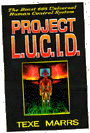 The insider information we have obtained onL.U.C.I.D.© is tremendously important, unbelievably vital, and earthshaking. So much so, that I have produced a special book exposing this monstrous project and warning of its deadly implications for Christian believers and American patriots. Order your personal copy of this investigative book, Project L.U.C.I.D.: The Beast 666 Universal Human Control System, by using our on-line shopping cart. For faster service, please call our order line, toll free, at 1-800-234-9673. The insider information we have obtained onL.U.C.I.D.© is tremendously important, unbelievably vital, and earthshaking. So much so, that I have produced a special book exposing this monstrous project and warning of its deadly implications for Christian believers and American patriots. Order your personal copy of this investigative book, Project L.U.C.I.D.: The Beast 666 Universal Human Control System, by using our on-line shopping cart. For faster service, please call our order line, toll free, at 1-800-234-9673. |
|