Verne Strickland Blogmaster / October 24, 2012
 NEWSMAX, Wed, Oct 24, 2012 7:21 pm
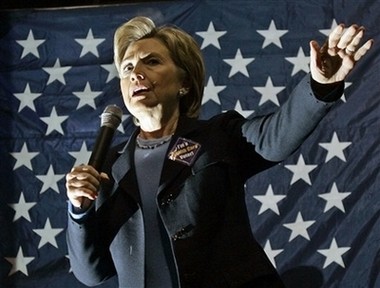
U.S. Secretary of State Hillary Clinton said on
Wednesday a Facebook post in which an Islamic militant group claimed
credit for a recent attack on the U.S. mission in Benghazi, Libya did
not constitute hard evidence of who was responsible.
"Posting something on Facebook is not in and of
itself evidence. I think it just underscores how fluid the reporting was
at the time and continued for some time to be," Clinton said during an
appearance with the Brazilian foreign minister at the State Department.
Reuters reported on Tuesday that an official
email showed officials at the White House and State Department were
advised two hours after attackers assaulted the U.S. diplomatic mission
on September 11 that an Islamic militant group had claimed credit.
The email, obtained by Reuters from government
sources not connected with U.S. spy agencies or the State Department and
who requested anonymity, specifically mentioned that the Libyan group
called Ansar al-Sharia had asserted responsibility for the attacks.
That and two other emails also made available
showed how U.S. diplomats described the attack, even as it was still
under way, to Washington.
Clinton, responding to a reporter's question about the emails, noted that a State Department investigation was under way.
"The independent accountability review board is
already hard at work looking at everything, not cherry picking one story
here or one document there, but looking at everything -- which I highly
recommend as the appropriate approach for something as complex as an
attack like this," she said.
"We will find out what happened. We will take
whatever measures are necessary to fix anything that needs to be fixed
and we will bring those to justice who committed these murders."
White House spokesman Jay Carney, asked about the
emails, noted that Ansar al-Sharia had later denied responsibility for
the attack.
"This was an open-source, unclassified email
about a posting on a Facebook site. I would also note I think that
within a few hours, that organization itself claimed that it had not
been responsible. Neither should be taken as fact -- that's why there's
an investigation under way," he told reporters traveling with President
Barack Obama aboard Air Force One to Iowa.
U.S. Ambassador Christopher Stevens and three
other Americans were killed in the Benghazi assault, which Obama and
other U.S. officials ultimately acknowledged was a "terrorist" attack
carried out by militants with suspected links to al Qaeda affiliates or
sympathizers.
Administration spokesmen, including Carney,
citing an unclassified assessment prepared by the CIA, maintained for
days that the attacks likely were a spontaneous protest against an
anti-Muslim film.
While officials did mention the possible
involvement of "extremists," they did not lay blame on any specific
militant groups or possible links to al Qaeda or its affiliates until
intelligence officials publicly alleged that on September 28.
There were indications that extremists with
possible al Qaeda connections were involved, but also evidence that the
attacks could have erupted spontaneously, they said, adding that
government experts were cautious about pointing fingers prematurely.
U.S. intelligence officials have emphasized since
shortly after the attack that early intelligence reporting about the
attack was mixed.
The records obtained by Reuters consist of three
emails dispatched by the State Department's Operations Center to
multiple government offices, including addresses at the White House,
Pentagon, intelligence community and FBI, on the afternoon of September
11.
The first email, timed at 4:05 p.m. Washington
time -- or 10:05 p.m. Benghazi time, 20-30 minutes after the attack on
the U.S. diplomatic mission allegedly began -- carried the subject line
"U.S. Diplomatic Mission in Benghazi Under Attack" and the notation
"SBU", meaning "Sensitive But Unclassified."
The text said the State Department's regional
security office had reported that the diplomatic mission in Benghazi was
under attack. "Embassy in Tripoli reports approximately 20 armed people
fired shots; explosions have been heard as well," it said.
The message continued: "Ambassador Stevens, who
is currently in Benghazi, and four ... personnel are in the compound
safe haven. The 17th of February militia is providing security support."
A second email, headed "Update 1: U.S. Diplomatic
Mission in Benghazi" and timed 4:54 p.m. Washington time, said that the
Embassy in Tripoli had reported that "the firing at the U.S. Diplomatic
Mission in Benghazi had stopped and the compound had been cleared." It
said a "response team" was at the site attempting to locate missing
personnel.
A third email, also marked SBU and sent at 6:07
p.m. Washington time, carried the subject line: "Update 2: Ansar
al-Sharia Claims Responsibility for Benghazi Attack."
The message reported: "Embassy Tripoli reports
the group claimed responsibility on Facebook and Twitter and has called
for an attack on Embassy Tripoli."
While some information identifying recipients of
this message was redacted from copies of the messages obtained by
Reuters, a government source said that one of the addresses to which the
message was sent was the White House Situation Room, the president's
secure command post.
Other addressees included intelligence and military units as well as one used by the FBI command center, the source said.
It was not known what other messages were
received by agencies in Washington from Libya that day about who might
have been behind the attacks.
Intelligence experts caution that initial reports from the scene of any attack or disaster are often inaccurate.
By the morning of September 12, the day after the
Benghazi attack, Reuters reported that there were indications that
members of both Ansar al-Sharia, a militia based in the Benghazi area,
and al Qaeda in the Islamic Maghreb, the North African affiliate of al
Qaeda's faltering central command, may have been involved in organizing
the attacks.
One U.S. intelligence official said that during
the first classified briefing about Benghazi given to members of
Congress, officials "carefully laid out the full range of sparsely
available information, relying on the best analysis available at the
time."
The official added, however, that the initial analysis of the attack that was presented to legislators was mixed.
"Briefers said extremists were involved in
attacks that appeared spontaneous, there may have been a variety of
motivating factors, and possible links to groups such as (al Qaeda in
the Islamic Maghreb and Ansar al-Sharia) were being looked at closely,"
the official said.


