 | |
 | |
| |
Americans
for Prosperity (AFP) is a nationwide organization of citizen-leaders
committed to advancing every individual’s right to economic freedom
and opportunity. AFP believes reducing the size and intrusiveness of
government is the best way to promote individual productivity and
prosperity for all Americans. AFP educates and engages citizens to
support restraining state and federal government growth and returning
government to its constitutional limits. AFP is more than 1.9 million
activists strong, with activists in all 50 states. AFP has 35 state
chapters and affiliates. For more information, visit www.americansforprosperity.org
|
Saturday, December 1, 2012
"Bev" continues to add to her "legacy" with last-minute Dix deal.


Friday, November 30, 2012
CBS Radio Building hit by gunfire. At least 3 bullets strike office. No one reported hurt.
Verne Strickland Blogmaster / November 30, 2012
By Ryan Crowe & L.P. Phillips, CBSDFW.com
November 30, 2012 4:45 PM
DALLAS (CBSDFW.COM) – Shots ring out as someone opens fire on a Dallas office building, and a window belonging to NewsRadio 1080 KRLD is hit.The bullets went through the outside panes of glass on two floors of the 12-story CBS Radio building off Central Expressway at Fitzhugh Avenue.
One of the windows hit belongs to KRLD promotions director Matt Stacks, who was startled by the sound about 3:15 Friday afternoon.
Stacks initially thought a bird hit the 5th floor window. “I just heard a loud boom. I turned around and looked at my window and noticed it started splintering out and saw some stuff falling from the window above.”
KRLD’s L.P. Phillips talks with Stacks shortly after the incident:
The bullet shattered the entire outer window of the office located at the corner of the KRLD Newsroom.

An image from the office of attorney Pete Schulte, whose outer window was shattered by a bullet Friday afternoon.

A close-up image from the office of attorney Pete Schulte, whose outer window was shattered by a bullet Friday afternoon.

A view of the office of CBS Radio’s Matt Stacks, whose window was hit by a bullet Friday afternoon.

A view of the office of CBS Radio’s Matt Stacks, whose window was hit by a bullet Friday afternoon.

The view from Chopper 11 of workers removing windows at the CBS Radio building that were hit by bullets Friday afternoon.

The
view from Chopper 11 of a 105.3 The Fan sign put up in a window at the
CBS Radio building that was hit by a bullet Friday afternoon.

A wide image of the CBS Radio building that was hit by at least 3 bullets Friday afternoon.

A worker removing a window in the KRLD newsroom hit by a bullet Friday afternoon at the CBS Radio building in Dallas.
Nobody was hurt, but the fact the incident happened on a Friday off a busy highway like Central Expressway concerns Schulte.
“If it happens in the middle of the night that’s one thing, but I sit in this office every day. To have a gunshot in the middle of the afternoon with so many cars passing by, that’s unnerving.”
Schulte believes the shots came from the direction of Central Expressway, and were either fired from the freeway, or from the frontage road that the building faces.
Phillips talks with Schulte:
Schulte is known for representing high-profile clients like Pilar Sanders, the estranged wife of former Cowboys star Deion Sanders.
It is not clear if Schulte or any of the CBS Radio stations were targets of the shooting. In addition to KRLD, the building also houses offices for CBSDFW.com and radio stations 105.3 The Fan, 103.7 Lite FM, 100.3 Jack FM, 98.7 KLUV and Mega 107.5 FM on various floors.
105.3 The Fan’s ‘RAGE’ talks about the shooting on air Friday afternoon:
Dallas Police are on the scene investigating. CBSDFW.com will have updates as the story develops.
(©2012 CBS Local Media, a division of CBS Radio Inc. All Rights Reserved. This material may not be published, broadcast, rewritten, or redistributed.)
Thursday, November 29, 2012
Susan Rice reportedly has financial stake in Canadian tar sands industry -- direct link to Keystone XL pipeline.
RICE'S SECRETARY OF STATE HOPES COULD BE HANGING IN THE BALANCE.
Verne Strickland Blogmaster / November 29, 2012


Posted: 11/29/2012 5:43 pm EST Updated: 11/29/2012 6:42 pm EST
Susan Rice, the candidate believed to be favored by President Obama to become the next Secretary of State, holds significant investments in more than a dozen Canadian oil companies and banks that would stand to benefit from expansion of the North American tar sands industry and construction of the proposed $7 billion Keystone XL pipeline. If confirmed by the Senate, one of Rice’s first duties likely would be consideration, and potentially approval, of the controversial mega-project.
Rice's financial holdings could raise questions about her status as a neutral decision maker. The current U.S. ambassador to the United Nations, Rice owns stock valued between $300,000 and $600,000 in TransCanada, the company seeking a federal permit to transport tar sands crude 1,700 miles to refineries on the Texas Gulf Coast, crossing fragile Midwest ecosystems and the largest freshwater aquifer in North America.
Beyond that, according to financial disclosure reports, about a third of Rice’s personal net worth is tied up in oil producers, pipeline operators, and related energy industries north of the 49th parallel -- including companies with poor environmental and safety records on both U.S. and Canadian soil. Rice and her husband own at least $1.25 million worth of stock in four of Canada’s eight leading oil producers, as ranked by Forbes magazine. That includes Enbridge, which spilled more than a million gallons of toxic bitumen into Michigan’s Kalamazoo River in 2010 -- the largest inland oil spill in U.S. history.
Rice also has smaller stakes in several other big Canadian energy firms, as well as the country’s transportation companies and coal-fired utilities. Another 20 percent or so of her personal wealth is derived from investments in five Canadian banks. These are some of the institutions that provide loans and financial backing to TransCanada and its competitors for tar sands extraction and major infrastructure projects, such as Keystone XL and Enbridge’s proposed Northern Gateway pipeline, which would stretch 700 miles from Alberta to the Canadian coast.
In 2010, for instance, when Rice and her husband held at least $1.5 million in Royal Bank of Canada, the institution was labeled Canada's most environmentally irresponsible company by the Rainforest Action Network for its support of tar sands development. Public pressure from environmentalists and Canada’s First Nations tribes convinced the bank to adopt new standards regarding socially conscious lending.
“It’s really amazing that they’re considering someone for Secretary of State who has millions invested in these companies,” said Bill McKibben, a writer and founder of the activist groups 350.org and Tar Sands Action, which have organized protests against the Keystone XL project. “The State Department has been rife with collusion with the Canadian pipeline builders, and it’s really distressing to have any sense that that might continue to go on.”
Emails obtained by an environmental group last year show what critics call a “cozy and complicitous relationship” between State Department officials and a lobbyist for TransCanada, who was also a former deputy campaign director for current Secretary of State Hillary Clinton's failed 2008 presidential bid. The agency also assigned an environmental impact review of the Keystone project to a company with financial ties to TransCanada.
As ambassador to the United Nations, Rice has not been directly involved in the State Department’s Keystone XL review, which came to a head at the end of 2011. After initially indicating it would likely approve TransCanada’s application, the State Department ordered a review of alternate routes to avoid putting critical water sources in Nebraska at risk. The move, which officials said would likely push the approval process back to the first three months of 2013, was an attempt to spare the Obama administration a politically risky decision just before an election year.
Greenlighting the pipeline would have hurt the president with environmental advocates -- more than 1,200 people were arrested in anti-Keystone protests led by McKibben at the White House in Summer 2011. But denying it outright would have given Republicans an election year attack line, saying Obama had cost the nation much-needed jobs (although independent studies have shown that TransCanada’s job creation claims for the pipeline are greatly exaggerated). As it was, the president still received significant heat, and Mitt Romney pledged to approve the pipeline on Day 1 if he had won the election.
Were she to become Secretary of State, Rice would be in charge of the new environmental review process and would be in a position to decide whether to issue TransCanada a permit for sections of Keystone XL stretching from Oklahoma to the Canadian border. (The pipeline’s southernmost leg has already been approved and is under construction in Texas -- with protesters perching in trees and chaining themselves to construction equipment in an attempt to stop it.)
Rice is reportedly Obama’s favorite to take the helm at the State Department next year. Clinton has said repeatedly that she plans to step down shortly after Obama’s second inauguration in January. In addition to Rice, reportedly the president's lead candidate for the job, U.S. Senator John Kerry had also reportedly made it onto the president’s short list. Kerry, whose net worth of at least $232 million makes him far wealthier than Rice, does not own shares of TransCanada or Enbridge, the major tar sands pipeline companies, although he does have stock in some other Canadian energy interests.
According to the Center for Responsive Politics, Rice’s net worth sat somewhere between $23.5 million and $43.5 million in 2009, the latest year for which the center has done a full analysis of her finances. That makes her either the wealthiest person currently serving in the executive branch or a close second to Clinton. (The uncertainty surrounding these figures is due to the way officials are required to disclose their investments; instead of declaring the specific amount of stock they own, they are required by law only to declare a range.)
Other public officials have been criticized for pushing for the Keystone XL project while standing to benefit financially. The nonprofit Sunlight Foundation watchdog group reported in December 2011 that four members of Congress who own shares in TransCanada had pressed for the pipeline’s approval -- either by supporting bills that would have forced the State Department to issue a permit or by writing to Clinton or Obama, urging them to give the go-ahead. Rice’s ownership of TransCanada stock was noted by the Sunlight Foundation but not considered a conflict of interest at the time, because she had no direct role in the approval process.
Neither Rice’s office nor the White House returned OnEarth’s calls for comment about her financial holdings. It’s unclear when Rice began investing in Canadian energy and banks, but the Stanford University graduate and Rhodes Scholar worked for the prestigious McKinsey & Company consulting firm’s Toronto office from 1990 to 1993, marrying Canadian-born TV producer Ian Cameron in 1992. She then joined the National Security Council under President Bill Clinton. (Financial disclosure forms aren’t available for Rice’s security council tenure; by law, they’re destroyed after six years.) Rice later became President Clinton’s assistant secretary of state for African affairs, then joined the nonprofit Brookings Institution think tank during the George W. Bush administration. She advised both the Kerry and Obama presidential campaigns on foreign policy.
According to the reports she filed in May 2012, Rice and her husband have a wide-ranging portfolio that includes more than 100 securities, such as IBM, Monsanto, Apple, BP, and McDonald’s. Dan Auble, a researcher at the Center for Responsive Politics who studies the personal finances of public officials, said it’s not unusual to see energy investments play a significant role in their financial portfolios, as they do with Rice and her husband. (Auble said the holdings of a public official’s spouse are included in financial disclosure reports because they have the same potential to create a conflict of interest.) In their case, however, nine of the 14 holdings they claimed that top $500,000 are Canadian energy interests or banks.
If Rice does get the Secretary of State job, federal ethics officials could recommend that she sell her stock in TransCanada and related companies before deciding on Keystone XL, Auble said. But that’s not a sure thing.
Leading Keystone opponents say they wouldn’t necessarily oppose Rice’s nomination -- but they would want someone else in charge of deciding the pipeline’s fate. “It would be one of the first decisions she would make, and she’s not qualified to make an unbiased decision,” said Jane Kleeb, the executive director of Bold Nebraska, a group that has fought to block the Keystone XL pipeline.
“It’s one more clear sign that the State Department should not be handling this,” added McKibben (who is also an OnEarth contributing editor). Both advocates believe the Environmental Protection Agency or the White House Council on Environmental Quality would be more qualified to assess the environmental impacts of Keystone XL. But an executive order issued by President George W. Bush in April 2004 makes the Secretary of State responsible for approving pipelines that cross the U.S. border. Kleeb suggested that Obama could change that order to shift the decision-making responsibility elsewhere.
Environmental advocates (including the Natural Resources Defense Council, which publishes OnEarth) have sought to block the Keystone XL pipeline and further development of the Alberta tar sands fields due to their climate impact and potential for pollution and dangerous oil spills. Extracting bitumen -- a heavy, viscous black oil -- requires intensive open-pit mining in the heart of Canada’s boreal forest. More dirty and corrosive than conventional crude, bitumen requires extensive refining to become useable fuel. The entire process uses vast amounts of energy and water and creates three times the global warming pollution of conventional fuel, while shipping the bitumen through pipelines means an additional risk of corrosion and leaks.
Despite the environmental risks, tar sands development has become a major focus of the Canadian government and pillar of the country’s economy, championed by Prime Minister Stephen Harper, whose administration has denounced environmental advocates and First Nations tribes opposed to pipeline construction as extremists. Alberta's tar sands contain the world's third largest proven oil reserve, but they’re landlocked and remote -- hence the desire for more pipelines to provide Canadian energy companies with access to ports and refineries.
According to her most recent financial disclosure reports, along with her TransCanada investments, Rice and her husband own at least $1.5 million worth of stock in Enbridge (Canada’s No. 3 oil producer, according to Forbes), Cenovus (No. 7), and Encana (No. 8), as well as at least $1.25 million in Imperial (No. 2), $50,000 to $100,000 in Suncor (No. 1), and $15,000 to $50,000 in Canadian Natural (No. 6). (TransCanada is ranked at No. 5 by Forbes.) The couple has at least $1.25 million invested in Transalta, Alberta's largest coal-fired electricity power producer, and at least $1.5 million in Canadian Pacific Railway, which transports coal, oil, and gas and has been a major financial beneficiary of the North American energy boom.
On the banking side, Rice has investments totaling at least $5 million and up to $11.25 million in Bank of Montreal, Bank of Nova Scotia, Canadian Imperial Bank of Commerce, Royal Bank of Canada, and Toronto Dominion. A report by the Dutch consulting firm Profundo Economic Research says several of these same banks are largely responsible for underwriting the expansion of Canada’s tar sands industry. “Investment in tar sands infrastructure now surpasses that of manufacturing across all of Canada,” according to the report.
Which means that regardless of Keystone XL’s fate, Canadian companies will continue to seek ways to pump bitumen from northern Canada to coastal refineries and ports, where it can be shipped to Europe, China, and other overseas markets. NRDC and other environmental groups have presented evidence that Enbridge is making plans to reverse a pipeline that currently carries regular crude from the New England coast to Montreal, and use it to ship tar sands oil in the other direction instead.
Since it crosses the U.S.-Canadian border, that plan would also require State Department approval.
OnEarth editor-at-large Ted Genoways contributed to this report.
More from OnEarth
From The Mag: Canadian Democracy: Death by Pipeline
Web Exclusive: Tar Sands Showdown in the Nebraska Sandhills
From The Mag: Canada's Highway to Hell
More from NRDC
Issues: Stopping the Tar Sands Pipeline
Report: Tar Sands Pipelines Safety Risks
Blogs: Keystone XL on Switchboard
Wednesday, November 28, 2012
Raleigh store owner takes on liberal bureaucrats, socialist ideas!
Verne Strickland Blogmaster / November 28, 2012
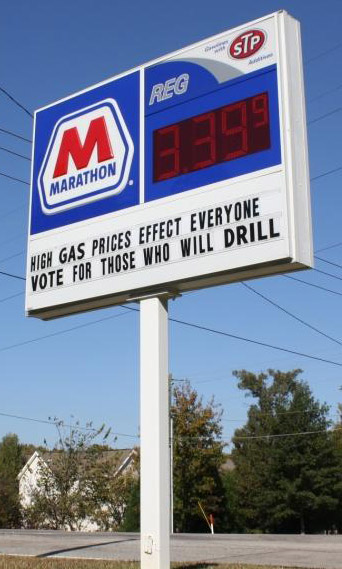
Every day I drive past a gas station and convenience store, the
Grocery Boy Junior on Lake Wheeler Road in Raleigh. A few weeks ago,
while fueling up there and muttering about high gas prices, I noticed
something on the marquee outside of the building:
“Socialism is a philosophy of failure, the creed of ignorance, and the gospel of envy, its inherent virtue is the equal sharing of misery.”
This quote from Winston Churchill is affixed to the cash register with two small pieces of tape, positioned perfectly to be noticed by anyone making a purchase.
A few weeks later, when I sat down with owner Scott Byers, he grabbed a pack of gum and took a piece for himself. He offered me a piece and sighed. “10 years ago, this pack of gum cost about half of what it does now,” he said, “and people just don’t seem to realize that fuel costs are a huge part of that.”
He said he came from a military upbringing and attended a two-year college. He is involved with his church, working with several ministries within the congregation. He has three children, and beams when he speaks about them. He has dreams for them like any parent would; but above all, he wants them to understand that they are responsible for their achievements, not entitled to them.
He explained that his income is now half of what it was four years ago, a common plight afflicting the small business sector. He spoke with sadness in his voice about the heartbreaking decision to let go of employees that had worked for nearly a decade in his store. “It’s hard to hear people demonizing their bosses,” he explained, “because it’s not easy for us to make those choices.”
When I asked how he felt about local government and the bureaucracy endured by many small business owners, Byers said that he had been faced with many hurdles from various state departments amid his efforts to improve his business. He noted that it seems like these departments whose intentions are to protect the people in fact make it more difficult for businesses to operate. He said that many of the changes he would like to make “just [aren’t] viable right now.”
When I asked Mr. Byers what issues he was taking to consideration aside from the economy in this year’s election, he did not even blink. Education, he said, was the root of most of our nation’s problems because it perpetuates the culture of entitlement. Secondly, of course, he continued, is the topic of offshore drilling. Mr. Byers rattled off facts that astonished me. After hearing him speak about drilling, I was ready to go drill for him. For instance, there are nearly 3,500 oil tankers in action today, raising the risk of oil spills in the world’s oceans. Drilling for oil and natural gas right here in North America lessens that danger.
Byers noted that the environmentalists, much like the various North Carolina departments that impose restrictions on his business practices, have good intentions — but do not seem to realize that fuel prices affect the whole economy. High fuel costs do not discriminate, according to Mr. Byers. “It’s not just the middle class, it’s everyone. And people need to consider that when they vote.”
Victoria Wakefield is an intern for the Civitas Institute in Raleigh.
“HIGH GAS PRICES [A]FFECT EVERYONE/ VOTE FOR THOSE WHO WILL DRILL”
The Grocery Boy Junior is an emblem of all things that embody the
passion — and the pain — of small businesses today. I was intrigued by
the marquee so much that I decided stop in and ask to chat with the man
responsible for it. As I waited to speak with the cashier, I noticed
something else: “Socialism is a philosophy of failure, the creed of ignorance, and the gospel of envy, its inherent virtue is the equal sharing of misery.”
This quote from Winston Churchill is affixed to the cash register with two small pieces of tape, positioned perfectly to be noticed by anyone making a purchase.
A few weeks later, when I sat down with owner Scott Byers, he grabbed a pack of gum and took a piece for himself. He offered me a piece and sighed. “10 years ago, this pack of gum cost about half of what it does now,” he said, “and people just don’t seem to realize that fuel costs are a huge part of that.”
He said he came from a military upbringing and attended a two-year college. He is involved with his church, working with several ministries within the congregation. He has three children, and beams when he speaks about them. He has dreams for them like any parent would; but above all, he wants them to understand that they are responsible for their achievements, not entitled to them.
He explained that his income is now half of what it was four years ago, a common plight afflicting the small business sector. He spoke with sadness in his voice about the heartbreaking decision to let go of employees that had worked for nearly a decade in his store. “It’s hard to hear people demonizing their bosses,” he explained, “because it’s not easy for us to make those choices.”
When I asked how he felt about local government and the bureaucracy endured by many small business owners, Byers said that he had been faced with many hurdles from various state departments amid his efforts to improve his business. He noted that it seems like these departments whose intentions are to protect the people in fact make it more difficult for businesses to operate. He said that many of the changes he would like to make “just [aren’t] viable right now.”
When I asked Mr. Byers what issues he was taking to consideration aside from the economy in this year’s election, he did not even blink. Education, he said, was the root of most of our nation’s problems because it perpetuates the culture of entitlement. Secondly, of course, he continued, is the topic of offshore drilling. Mr. Byers rattled off facts that astonished me. After hearing him speak about drilling, I was ready to go drill for him. For instance, there are nearly 3,500 oil tankers in action today, raising the risk of oil spills in the world’s oceans. Drilling for oil and natural gas right here in North America lessens that danger.
Byers noted that the environmentalists, much like the various North Carolina departments that impose restrictions on his business practices, have good intentions — but do not seem to realize that fuel prices affect the whole economy. High fuel costs do not discriminate, according to Mr. Byers. “It’s not just the middle class, it’s everyone. And people need to consider that when they vote.”
Victoria Wakefield is an intern for the Civitas Institute in Raleigh.
This article was posted in Environment by Victoria Wakefield on November 19, 2012 at 5:23 PM.
Tuesday, November 27, 2012
Muslim immigration means sexual jihad. We don't want more Muslims in U.S.
Verne Strickland Blogmaster / November 28, 2012
By Eugene Gant on November 24, 2012
AP described them as “four Southern California men” but of course
the most recent would-be terrorists arrested by the FBI were actually
three immigrants and one US-born Asian. Significantly, and ominously,
two had converted to radical Islam in the US—and one of them was a Mexican immigrant.
This current uptick
of Muslim terrorist activity in the U.S., combined with the simoom of
anti-American violence sweeping across the Islamic world, should teach
us one simple thing: we don’t want more Muslims here.
Ultimately, it doesn’t matter why ranting mobs attacked our embassies and consulates in Libya, killing an ambassador and two former Navy SEALs, to name just a few victims. Maybe they’re enraged about a silly film. Or maybe we’re see Muslim nature taking its course in a planned attack. Either way, Islam rears its ugly head.
And if what Americans and their elected
officials see on the tube isn’t enough to stop or at least severely
curtail Muslim immigration from the Third World, perhaps some other news
is: A Lebanese website published an unconfirmed report, misattributing the news
to Agence France Presse, that Ambassador Christopher Stevens’ Muslim
murderers sodomized and raped him. And an American homosexual blogger reported that Stevens was a homosexual.
Perhaps he wasn’t. Perhaps his captors
didn’t sexually brutalize him, alive or dead. Stevens’ autopsy has not
been released. And, of course, we can’t trust the Main Stream Media to tell us.
But this does gives us the opportunity to focus on another blessing of Muslim immigration: Jihadists do rape and use carnal humiliation to establish a climate of fear among the infidels. It’s happening in Occupied Europe—and it’s already happening here.
- In the 2004 Muslim terrorist attack on a school in Beslan, Russia, the orgy of violence and sexual torture boggled the mind. According to one account, the Muslims stabbed infants, and
screaming teenage girls were dragged into rooms adjoining the gymnasium where they were being held and raped by their Chechen [Muslim] captors who chillingly made a video film of their appalling exploits. … [C]hildren were forced to drink their own urine and eat the petals off the flowers they had brought their teachers after nearly three days without food or water.
- When Muslim terrorists struck in Mumbai, India, in 2008, launching attacks across the city, they went to work on the guests in the Taj Mahal Hotel. According to the account in the Mumbai Mirror, the savages sexually assaulted a rabbi and his pregnant wife and mutilated their genitals.
- Thanks to the Labour Party’s policy of importing as many of the huddled masses from the Third World as possible, Muslims sex traffickers have groomed thousands of British girls to become sex slaves. They rape girls as young as 12 years told, one report said, and their targets for grooming, another report flatly stated, are white.[ 'Sexual predators': Gang of Asian men weep as they are jailed for total of 32 years for abusing white girls as young as 12 Daily Mail, November 6, 2010]
A crime report on child sexual exploitation revealed
that “2,379 individuals were reported … as being possible offenders in
relation to street grooming and child sexual exploitation,” while “2,083
victims of child sexual exploitation were reported to” British
authorities. Their response: Politically Correct paralysis:
Police and social services have been
accused of fueling a culture of silence which has allowed hundreds of
young white girls to be exploited by Asian men for sex…
A senior officer at West Mercia police has called for an end to the ‘damaging taboo’ connecting on-street grooming with race.
…
And it’s happening here in the U.S. Forget about the honor killings Muhammed’s disciples have brought to the land of the free. Forget about Nidal Hasan, the Fort Hood jihadist. Forget about the rise of Sharia law. The sexual war of conquest has begun.
- In El Paso County, Colo., five Iraqis are charged with what one cop calls “most horrific sexual assaults I’ve seen in my career,” the local television station reported. “According to the affidavit, the victim described a conversation with the men that centered on how unhappy they were with the treatment they received in the United States.
The men also spoke about ‘the United States oppressing them and calling them terrorists.’” Maybe that’s because they are. [Suspects In Vicious Sex Assault Vacate Court Appearance, KKTV, August 27, 2012]
- In May, a court convicted a group of Somali Muslims for running a sex slavery ring. [3 convicted, 6 acquitted in sex trafficking case, May 04, 2012]
As Immigration and Customs Enforcement alleged in its account of the gang,
members and associates of the gangs transported underage Somali and African-American females from the Minneapolis area to Nashville for the purpose of having the females engage in sex acts for money and other items of value.
As in Britain, some of the girls were allegedly 13 years old and even younger. The defendants who faced trial in May were among a group of 29, including women, almost all Somali Muslims.[ Somalis face sex trafficking trial in Nashville, by Kristin M. Hall, AP, March 20, 2012]
Where did these Somalis come from? Not a
few of them came thanks to the State Department and its Leftist
religious co-conspirators, crazy Lutherans and Catholics who “resettled” thousands upon thousands—meaning they dropped the Africans into all-white American neighborhoods without asking the neighbors what they thought about it.
Refugee Resettlement Watch reports the grim numbers:
4,413 Somalis landed here between 1983 and 1993. Within the decade
after that, we had invited more than 41,000. And they still kept coming.
Between 2004 and 2011, just more than 50,000 arrived. Nearly 13,000
arrived in 2004 alone. And more than 10,000 arrived in each of the two
years after that. The total for the last 29 years is nearly 100,000.
…
That’s another reason the number of Muslims here has doubled since 2001. And no wonder the number of mosques has jumped 74 percent since 2000
Those numbers won’t slow down, the Pew Forum reported in 2011:
In the United States, for example, the population projections show the number of Muslims more than doubling over the next two decades, rising from 2.6 million in 2010 to 6.2 million in 2030, in large part because of immigration and higher-than-average fertility among Muslims. The Muslim share of the U.S. population (adults and children) is projected to grow from 0.8% in 2010 to 1.7% in 2030, making Muslims roughly as numerous as Jews or Episcopalians are in the United States today.
Americans should ask the Open Borders Left and its neocon auxiliaries at the Wall Street Journal Editorial Page
a few questions. As the Muslim population increases, will we witness
more or fewer honor crimes? Or terrorist attacks? Or religio-political
rapes?
And, given that Muslims have stoned Christians and tried to shut down
free speech in Dearbornistan, how long will it be before parts of
American cities are declared “gay-free zones” and young American women
start wearing “reverse chastity belts”?
When will a major American city go up in flames after a Muslim punk kills himself running from police—or someone inadvertently insults the pedophile Prophet?
Not too far in the future, if what’s past in Europe is prologue for us.
Read the complete post and contact the author at Vdare.
Monday, November 26, 2012
Obama: Premature babies aren't people. People are smarter and bigger. And they have clothes. Lots of them are black or tan.
Verne Strickland Blogmaster / November 26, 2012

Human Events
Barack Obama worked to allow a gruesome practice, in which babies
born alive after attempted abortions are left to die without medical
care, to continue in Illinois. National Review journalist David Freddoso’s new book, The Case Against Barack Obama, exposes the lengths to which Barack Obama went to protect this ghastly procedure.
Because of a loophole, doctors in Illinois had no legal obligation to treat these babies. Under the law, they were non-persons. Illinois legislators tried to close this loophole with a bill mandating that babies born alive during an abortion would have to be treated just like every other baby born prematurely. The same laws and the same rules of medical ethics would apply to these born, living babies as to any other born, living human being.
On the federal level a similar bill passed 98-0 garnering a yea vote from pro-abortion stalwart Barbara Boxer. But back in Illinois, Barack Obama had problems with this type of legislation. He spoke on the floor of the Illinois Senate in opposition to the Born Alive Infants Protection Act – in fact, he was the only senator to do so. The following year he spoke against the born alive bill again. As a rabid proponent of legalized abortion, Obama voted against the bill or worked for its defeat on three separate occasions.
From The Case Against Barack Obama:
The tiny newborn baby made very little noise as he struggled to breathe. He could not cry—he lacked the strength. He had been born four months premature. “At that age,” says nurse Jill Stanek, “their lungs haven’t matured.”
Stanek is the nurse who found herself cradling this tiny human being in her hands for all of his forty-five-minute lifetime. He was close to ten inches long. He weighed perhaps half a pound. It’s just a guess, no one had weighed or measured him at birth. No happy family had been there to welcome him into the world. No one was trying to save his life now, to put him into an incubator, to give him oxygen or nourishment. He had just been left to die.
Because of a loophole, doctors in Illinois had no legal obligation to treat these babies. Under the law, they were non-persons. Illinois legislators tried to close this loophole with a bill mandating that babies born alive during an abortion would have to be treated just like every other baby born prematurely. The same laws and the same rules of medical ethics would apply to these born, living babies as to any other born, living human being.
On the federal level a similar bill passed 98-0 garnering a yea vote from pro-abortion stalwart Barbara Boxer. But back in Illinois, Barack Obama had problems with this type of legislation. He spoke on the floor of the Illinois Senate in opposition to the Born Alive Infants Protection Act – in fact, he was the only senator to do so. The following year he spoke against the born alive bill again. As a rabid proponent of legalized abortion, Obama voted against the bill or worked for its defeat on three separate occasions.
From The Case Against Barack Obama:
The tiny newborn baby made very little noise as he struggled to breathe. He could not cry—he lacked the strength. He had been born four months premature. “At that age,” says nurse Jill Stanek, “their lungs haven’t matured.”
Stanek is the nurse who found herself cradling this tiny human being in her hands for all of his forty-five-minute lifetime. He was close to ten inches long. He weighed perhaps half a pound. It’s just a guess, no one had weighed or measured him at birth. No happy family had been there to welcome him into the world. No one was trying to save his life now, to put him into an incubator, to give him oxygen or nourishment. He had just been left to die.
Sunday, November 25, 2012
US, Obama choose stability over democracy in Egypt. We will get neither.
Verne Strickland Blogmaster / November 26, 2012

Read more on: Morsi and Israel, muhammad morsi, Obama and Morsi, Hilary Clinton, egypt, Egypt and Israel, Hamas and Egypt, Egyptian muslim brotherhood, muslim brotherhood, dictatorship, and democracy and dictatorship
Comments

Subscribe to:
Comments (Atom)