Friday, October 10, 2014

U.S. Marines, by order of Barack Obama, deploy from city of MORON Spain for fight against Ebola! A fool's errand.

By Verne Strickland USA DOT COM / October 10, 2014

You can't kill a disease with a bullet. But the disease can kill you. I agree with Marine Jude Eden that this demeaning decision by President Obama is despicable and deadly. I have said before, and I say it again here -- our fighting men and women should refuse this order! They go into a death trap. They are proud and they are fearless. But this is another chance for Obama to mock our military, and he is taking full advantage of it. He seems to be pimping for an enraged American to kill him for his disrespect of our Nation. "Suicide by Patriot" -- this, he may believe -- will make him a "martyr" like MLK. A vain hope. The man is insane. And do you note that our Marines are deploying from the Spanish city of "Moron"? Tells the story, doesn't it?

U.S. Marines deploy from Moron, Spain for hopeless Ebola fight. 

Oct. 8, 2014 - 06:00AM   |  
Liberia Races To Expand Ebola Treatment Facilities
Grave diggers prepare for new Ebola victims Tuesday outside a treatment center near Gbarnga, in Bong County in central Liberia. About 100 Marines based in Spain will deploy temporarily to West Africa to join the fight to contain the Ebola virus, a Pentagon official said. (John Moore / Getty Images)
By Andrew Tilghman
About 100 Marines based in Spain will deploy temporarily to West Africa to join the fight to contain the Ebola virus, a Pentagon official said.
The Marines, with the Marine Air-Ground Task Force Crisis Response Africa based in Moron, Spain, will depart today, spend the night in Senegal and continue on to the Liberian capital of Monrovia on Thursday, said Rear Adm. John Kirby, a Defense Department spokesman.
Their mission will be to “provide interim resupply and transportation support” for a few weeks until an Army unit arrives later this month to assume the mission in the longer term, Kirby said.
The Marines will bring four MV-22 Ospreys and two KC-130 Hercules aircraft to support the mission.
About 350 U.S. military personnel are now in Liberia, but more than 3,000 soldiers are slated to deploy during the next several weeks and increase the total force to as many as 4,000 troops.
Pentagon officials emphasize that troops will not provide medical care to, or have direct contact with, individuals infected with Ebola. The U.S. military mission is to support civilian health care efforts through construction of new facilities, providing logistics support and training locals in prevention methods.
Protocols for ensuring U.S. personnel do not contract the potentially deadly disease will include wearing gloves and masks, but not complete full-body protective suits. They will wash their hands and feet multiple times a day.
The vast majority of troops deploying to Liberia will be soldiers from Fort Campbell, Kentucky, and Fort Hood, Texas. In addition, at least 700 combat engineers from across the Army will be tapped for the mission.
More than 3,400 people have died in West Africa form the Ebola virus and an estimated 7,470 have been diagnosed as having the infection, although the numbers likely are higher since many victims don’t make it to treatment centers.

Wednesday, October 8, 2014

North Carolina Decimated by Influenza Pandemic of 1918 - 1919: Here Is the True Story of This Unprecedented Tragedy. he Largely Untold Story

via Verne Strickland USA DOT COM  October 8, 2014


The influenza or flu pandemic of 1918 to 1919, the deadliest in modern history, infected an estimated 500 million people worldwide–about one-third of the planet’s population at the time–and killed an estimated 20 million to 50 million victims. More than 25 percent of the U.S. population became sick, and some 675,000 Americans died during the pandemic. 

The 1918 flu was first observed in Europe, the U.S. and parts of Asia before swiftly spreading around the world. Surprisingly, many flu victims were young, otherwise healthy adults. At the time, there were no effective drugs or vaccines to treat this killer flu strain or prevent its spread. In the U.S., citizens were ordered to wear masks, and schools, theaters and other public places were shuttered. Researchers later discovered what made the 1918 pandemic so deadly: In many victims, the influenza virus had invaded their lungs and caused pneumonia.


Influenza Outbreak of 1918-1919

by Steve Case, revised by Lisa Gregory, 2010
Government and Heritage Library
See also: NC and Influenza (WWI); Public Health; Infectious Diseases


From the Spring of 1918 through early 1919, as nations experienced the upheaval of World War One, an influenza pandemic ran through North Carolina. In April 1919, Dr. William Rankin, the Secretary of the State Board of Health and a noted proponent of health education, reported the death of over 13,600 North Carolinians from influenza, and estimated that approximately 1,000,000 of North Carolina's 2.5 million inhabitants had caught the disease. Nationally, the disease killed around 700,000, and some estimates suggest anywhere from 50 to 100 million died worldwide.
Detail from "The way North Carolinians do it at home." October 1919. The Health Bulletin, Vol 34, Issue 10.Known alternately as "the grippe," the "Spanish flu," and the "Spanish lady," the influenza A strain from this pandemic was particularly virulent, hitting the United States in multiple waves. There were a number of complicating factors that influenced the spread of the epidemic. Coming as it did during the height of the United States' involvement in World War One, such measures as the state took to combat the flu were often overshadowed by the patriotic fervor accompanying the war. In addition, the cause of the disease was unknown, and many hesitated even diagnosing it as influenza. Other diseases, like typoid fever and tuberculosis, were affecting the state at the same time. North Carolina, along with the rest of the nation, was slow to respond with basic measures like temporary hospitals and quarantine areas and relied on volunteers to treat the sick.
The pandemic appears to have struck earliest in Wilmington (Cockrell 311). Thereafter, information from military camps across the state documents the rise and fall of flu. Camps within North Carolina (Greene, Polk, Bragg) as well as those in South Carolina (Sevier, Jackson), to which many North Carolinians were sent for basic training, supplied statistics to the United States Public Health Service, which were compiled in weekly Public Health Reports. Also included in the reports were articles on treatment, court cases, analyses, and telegraphic reports from other countries.
As the pandemic subsided, new hospitals were built around the state to make up for the lack of facilities during the pandemic. The government and those in the medical field recognized and promoted the importance of health education, both for the general public and health professionals. The staggering death toll and the degree to which the medical community struggled to deal with the virulent disease ended up being a "modernizing factor on the state's social health services" (Cockrell 311).
References and additional resources:
Cameron, Annie Sutton. 1919. A record of the war activities in Orange County, North Carolina. 1917-1919. Call #566. Manuscripts Dept. Southern Historical Collection, UNC-Chapel Hill. http://docsouth.unc.edu/wwi/cameron/cameron.html
Cockrell, David L. 1996. "'A blessing in disguise': The influenza pandemic of 1918 and North Carolina's medical and public health communities." North Carolina Historical Review 73(3): 309-27. (At your library)
The deadly virus: The influenza epidemic of 1918. National Archives and Records Administration. http://www.archives.gov/exhibits/influenza-epidemic/

This is a second treatment of North Carolina's Fate During the 1918-1919 Influenza Pandemic

by Tom Belton
Reprinted with permission from Tar Heel Junior Historian, Spring 1993.
Tar Heel Junior Historian Association, NC Museum of History
See also: Public Health; Infectious Diseases; Influenza outbreak of 1918-1919
 Germany was not the only enemy North Carolinians faced during World War I. A silent foe stalked both soldier and civilian alike and slaughtered some twenty million people worldwide before it finally retreated. This enemy was a new strain of influenza nicknamed the “Spanish Lady”  The name came from a rumor that the disease had started in Spain.
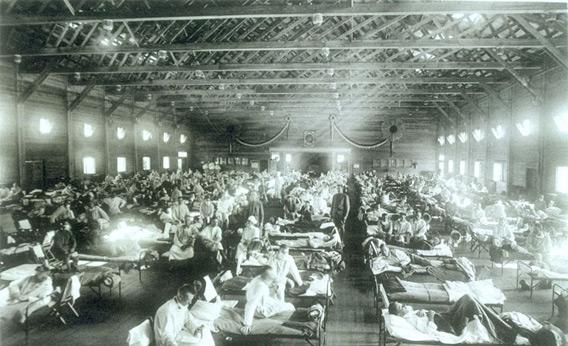
Influenza killed almost 500,000 Americans—ten times the number of American soldiers who died in combat during the war. American troop ships returning home with sick soldiers brought the flu to the home front. In a single week in October 1918, an estimated 21,000 Americans died. In North Carolina 13,644 people died before the epidemic finally went away. During its peak in October and November, there were only two kinds of people in the state—those who were sick with influenza and those who were trying to save them.
The illness sometimes lasted seven to ten days. It hit suddenly with chills, a high fever, upset stomach, weakness, and other symptoms. It continued until the patient either recovered or died. Influenza struck without regard to class and race, but the majority of victims were young adults between the ages of twenty and forty. Pregnant women had an especially hard time. Each day local newspapers listed names of citizens who had died since the last issue.
Mrs. C. R. Hudson lived near Oakwood Cemetery in Raleigh and recalled that “they died so fast they could not have proper burials. They couldn't dig graves fast enough.”  Dr. W. S. Rankin, secretary of the State Board of Health, recruited doctors and nurses for communities especially hard hit by influenza. The epidemic spread so rapidly that health officials often could not do much except offer advice through newspaper columns and health pamphlets.
Influenza spread when people were in close contact, so local health officers moved swiftly to close public schools and colleges, churches, theaters, fairs, and dance halls. Stores, textile mills, and other businesses also closed. Employees were either sick, afraid of getting sick, or at home taking care of the sick. Tar Heel communities looked like western ghost towns as residents remained inside their homes.
Few communities escaped the epidemic, and even fewer had the resources to care for the sick. Hospitals were not large enough to handle all the patients, so temporary hospitals opened in churches, schools, and armories. Doctors could not answer all of the calls of those affected, especially in farming communities. Many trained nurses had left to care for wounded soldiers, so communities often had to rely on women serving as volunteer nurses. Women also opened nurseries to care for the children of families stricken with influenza and labored in food kitchens to feed the children of the poor. Although the disease crossed all the lines of class and race, segregation policies required separate care for African-American and white victims. Still, white communities readily accepted the services of black nurses to care for their patients.
By the close of 1918, the worst months of the epidemic had passed. North Carolina soldiers in France had carefully followed reports of the flu at home through letters and newspapers. Many soldiers who faced death daily at the front mourned relatives who had died an ocean away from the war.
The citizens of Raleigh believed that those who had served as volunteers should be properly recognized for their work. These men and women had labored tirelessly in caring for others, and some had become ill and died as a result. In the early 1920s, a monument was put up on the Wake County Courthouse grounds in Raleigh. It honored those who had given their lives caring for others during the epidemic of 1918.

At the time of this article’s publication, Tom Belton served as curator of militaria, politics, and society for the North Carolina Museum of History. Belton previously served as executive secretary of the Tar Heel Junior Historian Association.

Ebola Death Doesn't Change Risk for Others

via Verne Strickland USA DOT COM 9/08/2014

Tuesday, October 7, 2014

Kay Hagan, Thom Tillis pull no punches in second debate


Kay Hagan, Thom Tillis pull no punches in second debate
 
cjarvis@newsobserver.com  October 7, 2014 

— Tuesday’s second debate between U.S. Sen. Kay Hagan and state House Speaker Thom Tillis picked up right where the candidates left off when they met last month, but with far more vigorous and direct criticism of each other.
He attacked the first-term Democrat as ineffective, liberal and part of Washington’s ills. She accused of him of callous Republican extremism.
Their talking points put them within the range of mainstream American politics today, on issues ranging from gay marriage to national security to unemployment, although they remained firmly divided.
The face-off, moderated by ABC News chief anchor George Stephanopoulos at the UNC-TV studios in Research Triangle Park, came just less than a month before the election. Both sides and their supporters have waged tens of millions of dollars’ worth of campaigning through TV and other ads – more spent on a race than in any other state this election – as the outcome could help decide the control of the Senate.
A third and final matchup will be held Thursday in Wilmington.
The fast-paced and occasionally personal tone was set with Hagan’s opening remarks: “Speaker Tillis has built a record of dividing our state, always putting the wealthy and big corporations first.” Later in the debate, she called Tillis “spineless” for criticizing President Barack Obama’s handling of the Islamic State militants in Syria and Iraq while refusing to say what he would do.
She also accused Tillis several times of not answering Stephanopoulos’ questions. “You want to ask him your question again?” she asked Stephanopoulos, who twice asked Tillis where he would part with Republican leadership in the Senate. (He later said he wouldn’t have supported shutting down the federal government due to automatic budget cuts under sequestration last year. She said she parted ways with Democrats on the Keystone oil pipeline and on the budget over military cuts.)
Tillis continued his theme tying Hagan to Obama, saying the November election will be a measure of the president’s policies, quoting the now-familiar figure that she has voted with Obama 96 percent of the time.
“I assume you’re proud you voted with him 96 percent of the time,” Tillis said. “I think it’s fair to make this election about his policies.”
Hagan’s response: “One hundred percent of the time Speaker Tillis’ policies have hurt North Carolina,” she said. “He’s gutted education, killed the equal pay bill, no Medicaid expansion.”
She said Tillis was erroneously trying to paint her as part of a liberal Washington establishment, reiterating her ranking as a moderate. “I am smack dab in the middle,” she said. “Smack dab in the middle is exactly where North Carolina is.”
Here are some of the other debate highlights:
Gay marriage
Asked on what grounds a challenge could be mounted to salvage North Carolina’s same-sex marriage ban, Tillis didn’t specify but said it would be pursued in spite of the U.S. Supreme Court’s decision this week not to take up several federal appeals court cases on the subject.
He said there are still circuit courts that haven’t ruled on the issue and that he hopes it will still go to the Supreme Court.
“I also think we’re in a dangerous time in this country where the president has appointed liberal activist judges and Sen. Hagan has confirmed them, and they’re literally trying to legislate from the bench,” he said.
Hagan noted she came out against the state’s constitutional ban, and added, “I don’t think anybody, including the government, should tell people who they should love.”
She criticized state legislative leaders for spending money on outside attorneys to pursue the matter, in the wake of the attorney general’s decision not to challenge the appeals court ruling.
National security
Tillis continued to attack Hagan for not being engaged enough on international terrorism issues despite her role as a member of the Senate Armed Services Committee, where she missed half of the public meetings, and chair of the Emerging Threats Subcommitttee. He asked her what was so important that she couldn’t attend those sessions.
She defended her diligence, saying she had taken an active interest in the issue beginning in early 2013, and challenged Tillis to come up with a better plan than what is underway with U.S. airstrikes and the arming of moderate rebels in Syria, noting Tillis recently said he didn’t know what the best approach was.
“I wonder how much more information I’d have if my senator from North Carolina, who sits on the Armed Services Committee, would show up for work,” Tillis shot back.
Ebola
Stephanopoulos noted Tillis recently called for a travel ban to West African countries in response to containing the Ebola disease threat, noting the Centers for Disease Control and Prevention director has said that would be counterproductive.
“I know the CDC is working hard,” Tillis said. “I don’t know that they’re working smart.”
He said a travel ban would give experts time to make sure the disease doesn’t spread further. “Until the CDC can convince me we’re able to intervene … then we’ve got to prevent them from traveling there,” he added.
In a rare overlapping of agreement, Hagan conceded that a travel ban might be one part of the answer. She said the United States needs to work with other countries but isolating them wouldn’t solve the problem.
She said Congress has allocated nearly $100 million for research and development of therapies that could be used and said Tillis’ remarks were “scare tactics.”
Unemployment
The candidates differed markedly on how to help people find jobs. Hagan called for tax reforms, including a repatriation bill she has sponsored with Republican Sen. John McCain of Arizona to give breaks to companies that return to this country and hire American workers.
“Sen. Hagan’s solution is spending more money,” Tillis said. “It’s very simple: Government needs to get out of the way. We need to get our spending under control and we need to reduce our regulations.”
Hagan retorted with a summary of the General Assembly’s actions under Tillis: “He’s sending our teachers to Texas, our film industry to Georgia, and Medicaid dollars to 28 other states. That’s his failed economic policy.”
Tillis, who in last month’s debate was criticized as being disrespectful by calling Hagan by her first name, stuck with referring to her as Sen. Hagan throughout the debate.


    Turkish Inaction on ISIS Advance Dismays the U.S. -- Bloodbath Feared, Obama Criticised

    Turkish Inaction on ISIS Advance Dismays the U.S. -- Bloodbath Feared

    Kurds in Suruc, Turkey, on Tuesday watching the fighting across the border in Kobani, Syria. There have been 18 airstrikes there. Credit Lefteris Pitarakis/Associated Press
    MURSITPINAR, Turkey — As fighters with the Islamic State bore down Tuesday on the Syrian town of Kobani on the Turkish border, President Obama’s plan to fight the militant group without being drawn deeper into the Syrian civil war was coming under acute strain.
    While Turkish troops watched the fighting in Kobani through a chicken-wire fence, Turkey’s president, Recep Tayyip Erdogan, said that the town was about to fall and Kurdish fighters warned of an impending blood bath if they were not reinforced — fears the United States shares.
    But Mr. Erdogan said Tuesday that Turkey would not get more deeply involved in the conflict with the Islamic State unless the United States agreed to give greater support to rebels trying to unseat the Syrian president, Bashar al-Assad. That has deepened tensions with President Obama, who would like Turkey to take stronger action against the Islamic State and to leave the fight against Mr. Assad out of it.
    Mr. Erdogan has also resisted pleas to send his troops across the border in the absence of a no-fly zone to ward off the Syrian Air Force.
     
    Even as it stepped up airstrikes against the militants Tuesday, the Obama administration was frustrated by what it regards as Turkey’s excuses for not doing more militarily. Officials note, for example, that the American-led coalition, with its heavy rotation of flights and airstrikes, has effectively imposed a no-fly zone over northern Syria already, so Mr. Erdogan’s demand for such a zone rings hollow.
    “There’s growing angst about Turkey dragging its feet to act to prevent a massacre less than a mile from its border,” a senior administration official said. “After all the fulminating about Syria’s humanitarian catastrophe, they’re inventing reasons not to act to avoid another catastrophe.
    “This isn’t how a NATO ally acts while hell is unfolding a stone’s throw from their border,” said the official, who spoke anonymously to avoid publicly criticizing an ally.
    Secretary of State John Kerry has had multiple phone calls in the last 72 hours with Turkey’s prime minister, Ahmet Davutoglu, and foreign minister, Mevlut Cavusoglu, to try to resolve the border crisis, American officials said.
    For Mr. Obama, a split with Turkey would jeopardize his efforts to hold together a coalition of Sunni Muslim countries to fight the Islamic State, also known as ISIS or ISIL. While Turkey is not the only country that might put the ouster of Mr. Assad ahead of defeating the radical Sunnis of the Islamic State, the White House has strongly argued that the immediate threat is from the militants.
    But if Turkey remains a holdout, it could cause other fissures in the coalition. It is not only a NATO ally but the main transit route for foreigners seeking to enlist in the ranks of the Islamic State.
    Ultimately, American officials said, the Islamic State cannot be pushed back without ground troops that are drawn from the ranks of the Syrian opposition. But until those troops are trained, equipped and put in the field, something that will take some time, officials said, Turkey can play a vital role.
     
     Turkish soldiers stood guard on Tuesday just across the border from Kobani, Syria. Credit Sedat Suna/European Pressphoto Agency
    “We have anticipated that it will be easier to protect population centers and to support offensives on the ground in Iraq, where we have partners” in the Kurdish pesh merga fighters and the Iraqi Army, said a senior administration official, who spoke on condition of anonymity to discuss internal deliberations. “Clearly, in Syria, it will take more time to develop the type of partners on the ground with whom we can coordinate.
    Speaking to reporters on Air Force One, Mr. Obama’s spokesman, Josh Earnest, said he was confident that the president’s recently appointed special envoy for Syria, retired Gen. John R. Allen, would be able to resolve some logistical issues regarding the Turkish military’s participation in the coalition. But he acknowledged that Turkey’s differing view of the need to oust Mr. Assad was likely to come up.
    While the diplomacy went ahead, the United States took pains to emphasize its support for the embattled Kurds in Kobani.
    The military’s Central Command confirmed on Tuesday that coalition aircraft had carried out five airstrikes against Islamic State positions in the Kobani area in the past two days, destroying or damaging armed vehicles, artillery, a tank and troop positions.
    The raids brought the number of airstrikes in and around Kobani to 18 — out of more than 100 in Syria altogether — since the air campaign was extended from Iraq to Syria.
    But Kurdish fighters in Kobani said they were running out of ammunition and could not prevail without infusions of troops and arms from Turkey. Independent analysts and some influential members of Congress concurred, deriding the airstrikes in Kobani as too little, too late.
    Kurdish fighters are under siege in Kobani, a key crossing into Turkey. Islamic State forces have cut off escape routes to the west, south and east. The Turkish Army is preventing escape and resupply across the border. 

    Turkish armored units enforce border crossing.


    World-wide Assessment of Ebola Spread and Outlook Reveals that the Challenge is Daunting

    Via USA DOT COM Verne Strickland  October 7, 2014

    World-wide Assessment of Ebola Spread and Outlook Reveals that the Challenge is Daunting

    U.S. To Increase Airport Screening For Ebola


    U.S. officials leading the fight against history's worst outbreak of Ebola have said they know the ways the virus is spread and how to stop it. They say that unless an air traveler from disease-ravaged West Africa has a fever of at least 101.5 degrees or other symptoms, co-passengers are not at risk.
    "At this point there is zero risk of transmission on the flight," Dr. Thomas Frieden, director of the federal Centers for Disease Control and Prevention, said after a Liberian man who flew through airports in Brussels and Washington was diagnosed with the disease last week in Dallas.

    Other public health officials have voiced similar assurances, saying Ebola is spread only through physical contact with a symptomatic individual or their bodily fluids. "Ebola is not transmitted by the air. It is not an airborne infection," said Dr. Edward Goodman of Texas Health Presbyterian Hospital in Dallas, where the Liberian patient remains in critical condition.
    Yet some scientists who have long studied Ebola say such assurances are premature — and they are concerned about what is not known about the strain now on the loose. It is an Ebola outbreak like none seen before, jumping from the bush to urban areas, giving the virus more opportunities to evolve as it passes through multiple human hosts.
    Dr. C.J. Peters, who battled a 1989 outbreak of the virus among research monkeys housed in Virginia and who later led the CDC's most far-reaching study of Ebola's transmissibility in humans, said he would not rule out the possibility that it spreads through the air in tight quarters.
    "We just don't have the data to exclude it," said Peters, who continues to research viral diseases at the University of Texas in Galveston.
     Dr. Philip K. Russell, a virologist who oversaw Ebola research while heading the U.S. Army's Medical Research and Development Command, and who later led the government's massive stockpiling of smallpox vaccine after the Sept. 11 terrorist attacks, also said much was still to be learned. "Being dogmatic is, I think, ill-advised, because there are too many unknowns here."

    Ailing in Monrovia, Liberia

    If Ebola were to mutate on its path from human to human, said Russell and other scientists, its virulence might wane — or it might spread in ways not observed during past outbreaks, which were stopped after transmission among just two to three people, before the virus had a greater chance to evolve. The present outbreak in West Africa has killed approximately 3,400 people, and there is no medical cure for Ebola.
    "I see the reasons to dampen down public fears," Russell said. "But scientifically, we're in the middle of the first experiment of multiple, serial passages of Ebola virus in man.... God knows what this virus is going to look like. I don't."

    Tom Skinner, a spokesman for the CDC in Atlanta, said health officials were basing their response to Ebola on what has been learned from battling the virus since its discovery in central Africa in 1976. The CDC remains confident, he said, that Ebola is transmitted principally by direct physical contact with an ill person or their bodily fluids.
    Skinner also said the CDC is conducting ongoing lab analyses to assess whether the present strain of Ebola is mutating in ways that would require the government to change its policies on responding to it. The results so far have not provided cause for concern, he said.
    The researchers reached in recent days for this article cited grounds to question U.S. officials' assumptions in three categories.

    One issue is whether airport screenings of prospective travelers to the U.S. from West Africa can reliably detect those who might have Ebola. Frieden has said the CDC protocols used at West African airports can be relied on to prevent more infected passengers from coming to the U.S.
    "One hundred percent of the individuals getting on planes are screened for fever before they get on the plane," Frieden said Sept. 30. "And if they have a fever, they are pulled out of the line, assessed for Ebola, and don't fly unless Ebola is ruled out."
    Individuals who have flown recently from one or more of the affected countries suggested that travelers could easily subvert the screening procedures — and might have incentive to do so: Compared with the depleted medical resources in the West African countries of Liberia, Sierra Leone and Guinea, the prospect of hospital care in the U.S. may offer an Ebola-exposed person the only chance to survive.

    A person could pass body temperature checks performed at the airports by taking ibuprofen or any common analgesic. And prospective passengers have much to fear from identifying themselves as sick, said Kim Beer, a resident of Freetown, the capital of Sierra Leone, who is working to get medical supplies into the country to cope with Ebola.
    "It is highly unlikely that someone would acknowledge having a fever, or simply feeling unwell," Beer said via email. "Not only will they probably not get on the flight — they may even be taken to/required to go to a 'holding facility' where they would have to stay for days until it is confirmed that it is not caused by Ebola. That is just about the last place one would want to go."
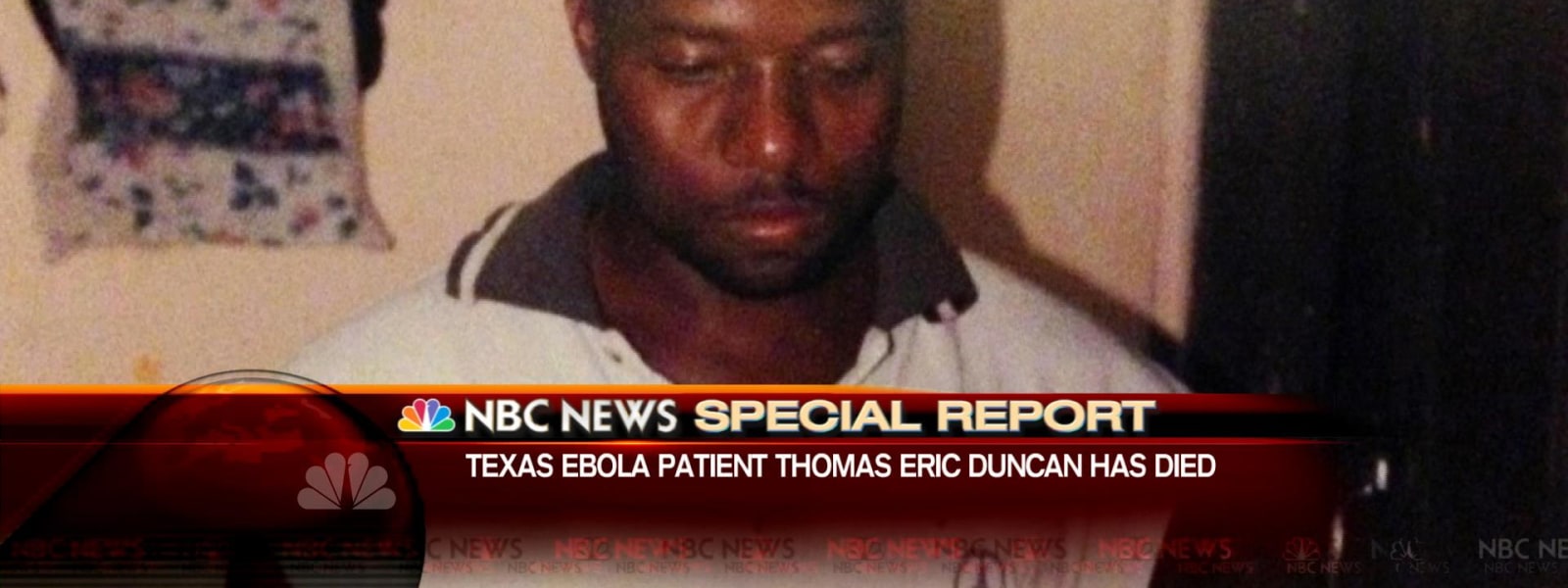
    Liberian officials said last week that the patient hospitalized in Dallas, Thomas Eric Duncan, did not report to airport screeners that he had had previous contact with an Ebola-stricken woman. It is not known whether Duncan knew she suffered from Ebola; her family told neighbors it was malaria.
    The potential disincentive for passengers to reveal their own symptoms was echoed by Sheka Forna, a dual citizen of Sierra Leone and Britain who manages a communications firm in Freetown. Forna said he considered it "very possible" that people with fever would medicate themselves to appear asymptomatic.
    Deadly Ebola outbreak spreads in West Africa
    It would be perilous to admit even nonspecific symptoms at the airport, Forna said in a telephone interview. "You'd be confined to wards with people with full-blown disease."

    On Monday, the White House announced that a review was underway of existing airport procedures. Frieden and President Obama's assistant for homeland security and counter-terrorism, Lisa Monaco, said Friday that closing the U.S. to passengers from the Ebola-affected countries would risk obstructing relief efforts.

    CDC officials also say that asymptomatic patients cannot spread Ebola. This assumption is crucial for assessing how many people are at risk of getting the disease. Yet diagnosing a symptom can depend on subjective understandings of what constitutes a symptom, and some may not be easily recognizable. Is a person mildly fatigued because of short sleep the night before a flight — or because of the early onset of disease?

    Moreover, said some public health specialists, there is no proof that a person infected — but who lacks symptoms — could not spread the virus to others.

    "It's really unclear," said Michael Osterholm, a public health scientist at the University of Minnesota who recently served on the U.S. government's National Science Advisory Board for Biosecurity. "None of us know."
    Russell, who oversaw the Army's research on Ebola, said he found the epidemiological data unconvincing.

    "The definition of 'symptomatic' is a little difficult to deal with," he said. "It may be generally true that patients aren't excreting very much virus until they become ill, but to say that we know the course of [the virus' entry into the bloodstream] and the course of when a virus appears in the various secretions, I think, is premature."
    The CDC's Skinner said that while officials remained confident that Ebola can be spread only by the overtly sick, the ongoing studies would assess whether mutations that might occur could increase the potential for asymptomatic patients to spread it.
    Ebola prevention in L.A. County: Officials will outline what's being doneFinally, some also question the official assertion that Ebola cannot be transmitted through the air. In late 1989, virus researcher Charles L. Bailey supervised the government's response to an outbreak of Ebola among several dozen rhesus monkeys housed for research in Reston, Va., a suburb of Washington.
    What Bailey learned from the episode informs his suspicion that the current strain of Ebola afflicting humans might be spread through tiny liquid droplets propelled into the air by coughing or sneezing.

    "We know for a fact that the virus occurs in sputum and no one has ever done a study [disproving that] coughing or sneezing is a viable means of transmitting," he said. Unqualified assurances that Ebola is not spread through the air, Bailey said, are "misleading."
    Peters, whose CDC team studied cases from 27 households that emerged during a 1995 Ebola outbreak in Democratic Republic of Congo, said that while most could be attributed to contact with infected late-stage patients or their bodily fluids, "some" infections may have occurred via "aerosol transmission."

    Skinner of the CDC, who cited the Peters-led study as the most extensive of Ebola's transmissibility, said that while the evidence "is really overwhelming" that people are most at risk when they touch either those who are sick or such a person's vomit, blood or diarrhea, "we can never say never" about spread through close-range coughing or sneezing.
    "I'm not going to sit here and say that if a person who is highly viremic … were to sneeze or cough right in the face of somebody who wasn't protected, that we wouldn't have a transmission," Skinner said.
    Peters, Russell and Bailey, who in 1989 was deputy commander for research of the Army's Medical Research Institute of Infectious Diseases, in Frederick, Md., said the primates in Reston had appeared to spread Ebola to other monkeys through their breath.


    Though he acknowledged that the means of disease transmission among the animals would not guarantee the same result among humans, Bailey said the outcome may hold lessons for the present Ebola epidemic.
    "Those monkeys were dying in a pattern that was certainly suggestive of coughing and sneezing — some sort of aerosol movement," Bailey said. "They were dying and spreading it so quickly from cage to cage. We finally came to the conclusion that the best action was to euthanize them all."
    david.willman@latimes.com
    Copyright © 2014, Los Angeles Times

    Monday, October 6, 2014

    "The Great Influenza" by John Barry reveals how devastating a global Ebola pandemic can be.


    Influenza epidemic of 1918 foreshadows global devastation that worldwide Ebola spread could wreak in 2014!


    An Ebola epidemic of global dimensions is a tragedy which would not be new to America or the world. The Great Influenza of 1918 reveals how that raging virus killed as many as 100 million people worldwide. Prepare yourself by going behind the scenes in a disease onslaught that killed more victims in 24 hours than AID has in 24 years!


    By Verne Strickland October 6, 2014

    As Ebola sends shock waves across the world, most don't know that an influenza pandemic in 1918-19 reveals what it could be like -- as what we fear now has already happened.

    One of the most powerful books of historical non-fiction I have ever read is
    THE GREAT INFLUENZA by John Barry. It is available at good prices from Amazon.

    At the height of WWI, history’s most lethal influenza virus erupted in an army camp in Kansas, moved east with American troops, then exploded, killing as many as 100 million people worldwide.

    It killed more people in twenty-four months than AIDS killed in twenty-four years, more in a year than the Black Death killed in a century.

    But this was not the Middle Ages, and 1918 marked the first collision of science and epidemic disease. Magisterial in its breadth of perspective and depth of research and now revised to reflect the growing danger of the avian flu, author John M. Barry's landmark work The Great Influenza is ultimately a tale of triumph amid tragedy, which provides us with a precise and sobering model as we confront the epidemics looming on our own horizon.

    Barry has written a new afterword for this edition that brings us up to speed on the terrible threat of the avian flu and suggest ways in which we might head off another flu pandemic. I read the book several years ago. It is not to be forgotten.

    Purchase it a low prices through Amazon.com.