Thursday, January 1, 2015

'A living hell' for slaves on remote South Korean islands

SINUI ISLAND, South Korea (AP) — He ran the first chance he got.
The summer sun beat down on the shallow, sea-fed fields where Kim Seong-baek was forced to work without pay, day after 18-hour day mining the big salt crystals that blossomed in the mud around him. Half-blind and in rags, Kim grabbed another slave, and the two men — both disabled — headed for the coast.
Far from Seoul, the glittering steel-and-glass capital of one of Asia's richest countries, they were now hunted men on this tiny, remote island where the enslavement of disabled salt farm workers is an open secret.
"It was a living hell," Kim said. "I thought my life was over."
Lost, they wandered past asphalt-black salt fields sparkling with a patina of thin white crust. They could feel the islanders they passed watching them. Everyone knew who belonged and who didn't.
Near a grocery, the store owner's son came out and asked what they were doing. Kim broke down, begged for help, said he'd been held against his will. The man offered to take them to the police to file a report. Instead, he called their boss, who beat Kim with a rake — and it was back to the salt fields.
"I couldn't fight back," Kim said, in a recent series of interviews with The Associated Press whose details are corroborated by court records and by lawyers, police and government officials. "The islanders are too organized, too connected."
___
Slavery thrives on this chain of rural islands off South Korea's rugged southwest coast, nurtured by a long history of exploitation and the demands of trying to squeeze a living from the sea.
Five times during the last decade, revelations of slavery involving the disabled have emerged, each time generating national shame and outrage. Kim's case prompted a nationwide government probe over the course of several months last year. Officials searched more than 38,000 salt, fish and agricultural farms and disabled facilities and found more than 100 workers who had received no — or only scant — pay, and more than 100 who had been reported missing by their families.
Yet little has changed on the islands, according to a months-long investigation by the AP based on court and police documents and dozens of interviews with freed slaves, salt farmers, villagers and officials.
Although 50 island farm owners and regional job brokers were indicted, no local police or officials have faced punishment — and national police say none will, despite multiple interviews showing some knew about the slaves and even stopped escape attempts.
Slavery has been so pervasive that regional judges have shown leniency toward several perpetrators. In suspending the prison sentences of two farmers, a court said that "such criminal activities were tolerated as common practice by a large number of salt farms nearby."
The AP findings shine a spotlight on the underbelly of an Asian success story. After decades of war, poverty and dictatorship, South Koreans now enjoy a vibrant democracy and media, and an entertainment industry that's the envy of the region. But amid the country's growing wealth and power, the disabled often don't fit in.
Soon after the national government's investigation, activists and police found another 63 unpaid or underpaid workers on the islands, three-quarters of whom were mentally disabled.
Yet some refused to leave the salt farms because they had nowhere else to go. Several freed disabled slaves told the AP they will return because they believe that even the salt farms are better than life on the streets or in crowded shelters. In some cases, relatives refused to take the disabled back or sent salt farmers letters confirming that they didn't need to pay the workers.
Kim's former boss, Hong Jeong-gi, didn't respond to multiple requests for comment through his lawyer, but argued in court that he didn't confine the two men. Hong is set to appear next week in court to appeal a 3½-year prison sentence.
Other villagers, including paid salt workers, say farmers do the best they can despite little help from the government, and add that only a few bad owners abuse workers. Farmers describe themselves as providing oases for the disabled and homeless.
"These are people who are neglected and mistreated, people who have nowhere to go," Hong Chi-guk, a 64-year-old salt farmer in Sinui, told the AP. "What alternative does our society have for them?"
___
On the night of July 4, 2012, a stranger approached Kim in a Seoul train station where he was trying to sleep; Kim had been homeless since fleeing creditors a decade earlier. The man offered him lodging for the night and promised him food, cigarettes and a "good job" in the morning.
Hours later, Kim stood in the muck of a salt farm owned by Hong, who had paid an illegal job agent the equivalent of about $700 for his new worker, according to court records.
Kim, visually disabled and described in court documents as having the social awareness of a 12-year-old, had no money, no cellphone and only the vaguest idea of where he was.
The afternoon of his first full day on the farm, Hong erupted as Kim struggled with the backbreaking work, according to the prosecutors' indictment that a judge based Hong's sentence on. The owner grabbed him from behind and flipped him onto the ground, screaming, "You moron. If I knew you'd be so bad at this, I wouldn't have brought you here."
In the next weeks, Hong punched him in the face for not cleaning floors properly. He beat him on the buttocks with a wooden plank for raking the salt in the wrong way.
"Each time I tried to ask him something, his punch came first," Kim told the AP. "He told me to use my mouth only for eating and smoking. He said I shouldn't question things and should be thankful because he fed me and gave me lodging and work."
It was just as bad for the other slave, Chae Min-sik, a tiny man whose disabilities are so severe that he struggles even with basic words.
Only a week after his first capture, Kim began to plan another escape.
___
"Angel Islands," the regional tourist board calls the 1,004 islands clustered in the sun-sparkling waters off South Korea's southwestern tip, because the Korean word for "1,004" sounds like the word for "angel."
Local media call them "Slave Islands."
Parts of the region have been shut out from the country's recent meteoric development. On many of the 72 inhabited islands, salt propels the economic engine, thanks to clean water, wide-open farmland and strong sunlight.
Sinan County has more than 850 salt farms that produce two-thirds of South Korea's sea salt. To make money, however, farmers need labor, lots of it and cheap. Around half of Sinui Island's 2,200 people work in salt farming, according to a county website and officials.
Even with pay, the work is hard.
Large farms in Europe can harvest salt once or twice a year with machines. But smaller Korean farms rely on daily manpower to wring salt from seawater.
Workers manage a complex network of waterways, hoses and storage areas. When the salt forms, they drain the fields, rake the salt into mounds, clean it and bag it. The process typically takes 25 days.
Sinan salt, which costs about three times more than refined salt, is coveted in South Korea, found in fancy department stores and given as wedding gifts.
"Everyone makes money from the farms," said Choi Young-shim, the owner of a fish restaurant in Mokpo, the southern port city that's the gateway to the salt islands.
Not everyone.
___
The second time they ran, Kim and Chae again tried to find their way to the port. But they had to pass the grocery store to get there, and again the store owner's son, identified by officials only as Yoon, rounded them up and called Hong.
After another beating, it was back to work. The few hours they weren't in the fields, they slept in a concrete storage building filled with piles of junk and large orange sacks of rice.
Kim despaired of ever escaping. Hong was an influential man, a former village head. He was linked by regular social contact and family ties with other salt farmers and villagers, some of whom volunteered to patrol the island for escaped workers.
Although Kim lived only 3 kilometers from a police station, he never thought about asking for help. He believed he'd be ignored or, worse, returned.
Kim ran again at the end of the month. Hong quickly called members of the volunteer patrol, and, again, Yoon spotted the slaves as they tried to reach the port and brought them to Hong.
Furious, the owner issued an ultimatum: Run again, and you'll get a knife in the stomach.
Hong beat Kim so badly he broke Kim's glasses, leaving him nearly blind. He worked Kim so hard the slave was too tired to think about escape, even if he hadn't been terrified to try.
"It just drove me deeper into despair," Kim said. "I never had a chance."
___
The exact number of people enslaved on the islands is difficult to determine for the same reasons that slavery lingers: the transient nature of the work, the remoteness of the farms and the closeness — and often hostility — of the island communities.
"It's like a game of hide-and-seek," said Park Su-in, an activist. "What we are finding is just the tip of the iceberg. It's hard to comprehend how bad it is for the disabled people who are forced to work out on these isolated islands."
Activists believe many slaves have yet to be found, as some salt farm owners sent victims away or hid them from investigators. They say others coached disabled workers about what they should say in interviews.
While island police officers were moved to different posts on the mainland as part of annual personnel changes, authorities found no collusion, according to a Mokpo police official who spoke on condition of anonymity because of office rules.
"If the recent investigation was done properly, then pretty much everyone on the island should've been taken to the police station and charged," said Kim Kang-won, another activist who participated in the recent investigation on Sinui. "The whole village knew about it. The local government office, and the police as well. It is clear negligence. And the problem hasn't been resolved yet."
Provincial police vowed to inspect farms and interview workers regularly. Choi Byung-dai, a police officer on Sinui Island when Kim was freed, expressed regret about Kim's treatment but also noted the difficulty of monitoring so many salt farms and a flood of seasonal workers.
Salt farmers blame illegal job agencies in Mokpo, which see mentally disabled workers as better bets because they're less likely to complain or run away.
"They're treated like dogs and pigs, but people in the community are used to it," said Kim Kyung-lae, a Mokpo cab driver who regularly drives local employment agents and disabled workers to the ferry port to meet with farm owners.
Others familiar with the island confirm that slavery is rampant.
A doctor who worked at the Sinui Island public health center from 2006 to 2007 said most of the workers he treated were abused or exploited.
"The police chief would tell me that I'd eventually come to understand that this was how things on the island worked," said Cho Yong-su. "For decades they'd exploited workers in this way, so they couldn't understand that this was abuse."
An outsider might cringe at what's happening on the island, said Han Bong-cheol, a pastor in Mokpo who lived on Sinui for 19 years until June. "But when you live there, many of these problems feel inevitable."
He sympathized with farmers forced to deal with disabled, incompetent workers whom he described as dirty and lazy. "They spend their leisure time eating snacks, drinking alcohol and smoking cigarettes. They are taken once or twice a year to Mokpo so they can buy sex. It's a painful reality, but it's a pain the island has long shared as a community," Han said.
___
After a year and a half as a slave, Kim made one last bid for freedom.
He wrote a letter to his mother in Seoul that he never expected to be able to send, calling himself her "foolish" son.
He got a break when Hong's wife let him go alone for a haircut. Walking slowly without his glasses, he ducked into the post office and mailed the letter, which gave directions to the farm.
Kim's mother was stunned. She brought the letter to Seo Je-gong, a police captain for the Seoul Guro district. "A vanished person had suddenly reappeared," Seo, now retired, told AP.
Seo then hatched an extraordinary plan.
Because Kim's letter noted collaboration between local police and salt farm owners, Seo and another Seoul officer ran a clandestine operation without telling local officials.
Carrying fishing rods, they walked around like tourists who had come to fish and buy salt, and surreptitiously took photos of Hong's house and farm. After they watched Hong board a boat, they told Hong's wife they were Seoul police who had come to free Kim.
The officers found the slaves sitting on a mattress in the back room of a storage building with no heat or hot water. Kim wore thin, dirty clothes, slippers and socks with big holes. He looked, Seo said, like a person who had been homeless for a very long time.
Kim was frightened and baffled at first, then relieved. "I am going to live," he said.
When Seo took Kim to a local police station to give an official account, an indignant policeman asked, "Why didn't you leave this to us?"
Villagers, unaware that Kim's escorts were Seoul police, harassed him at the docks, asking where he was going. Some even called Hong.
When Kim met his mother the next day, they both wept. She stroked her son's face. "Everything is all right because you've come back alive," she says in a police video of their reunion.
Chae initially refused to leave Sinui. After Seo later found a 2008 missing person's report for Chae, police returned and rescued him. Chae, who'd spent five years as a slave, now lives in a Seoul shelter.
Hong was convicted of employing a trafficked person, aggravated confinement, habitual violence and violating labor laws. Yoon, the man who captured Kim and Chae three times, was fined $7,500. Two illegal job brokers hired by Hong to procure workers are appealing prison sentences of 2 years and 2 ½ years.
Kim, who lives in Seoul and occasionally works construction jobs, still seems amazed that his escape plan worked. He settled with Hong for about $35,000 in unpaid wages, but is furious that Hong is appealing his prison term next week. Kim will face him in court, and has been preparing for the moment.
His body aches, and he gets treatment for lingering pain in his neck, legs and spine.
"Now all I want is peace," Kim said. "I still get nightmares, still wake up in the middle of the night."
His time as a slave has even changed the way he feels about salt. He gets flustered when he talks about it, disgusted when he sees it.
"Just thinking about it makes me grind my teeth."
___
Foster Klug is AP's Seoul bureau chief. Follow him on Twitter at twitter/apklug

AP EXCLUSIVE: S. Korea's Exploited Salt Workers
AP


Sharia LawThis State Banned It – Now Muslims and Liberals Are Outraged!

via Verne Strickland / usa dot com  12/30/14

This State Banned Sharia Law – Now Muslims and Liberals Are Outraged

Sharia-law-Billboard
Last week’s midterm elections included a proposed amendment to the Alabama State Constitution, preemptively banning Sharia Law. When voters went to the polls, they passed the law, known as Alabama Statewide Amendment 1, by a wide margin. The amendment specifically bans the consideration of foreign codes of law, particularly Islamic Sharia Law. The provision on the ballot read:
Called “The American and Alabama Laws for Alabama Courts Amendment,” Amendment 1 relates to the application of foreign law during the legal process involving an Alabama citizen. Foreign law refers to the laws of other countries or cultures. Currently, judges or other legal authorities discern whether foreign law is applied. Amendment 1 would create constitutional protection that foreign law is not applied if it violates the guaranteed rights of Alabama citizens.”
Muslims and Liberals across Alabama, and even outside the state, are up in arms. The Council on American-Islamic Relations (CAIR) issued a statement on Facebook calling the amendment “virulently racist” and indicative of “outright hostility toward Muslims.”
Liberals argued the amendment was racist and Islamophobic. They also deemed it unnecessary, since Sharia law has not been proposed in Alabama. Supporters of the amendment, however, made the case it was important to establish a position on use of a foreign legal system before the issue arose.
In European countries where there are significant Muslim populations, Sharia law has become a hotly-debated issue. England, for example, has permitted aspects of Sharia law, resulting in legal and cultural confusion. The difficulties posed are described in an article on RT UK:
womeninveils
Sharia principles are to become enshrined in the UK legal system for the first time, with The Law Society publishing guidelines for drawing up documents according to Islamic rules, which would exclude non-believers and encroach on women’s rights.
The new guidelines were produced by The Law Society earlier this month. Under the guidance, High Street solicitors will be able to write Islamic wills which will have the power to exclude non-believers completely and deny women an equal share of an inheritance.
“The male heirs in most cases receive double the amount inherited by a female heir of the same class. Non-Muslims may not inherit at all, and only Muslim marriages are recognized,” states the document.
Any children who have been born outside of marriage and even kids who have been adopted will also not be recognized as legitimate heirs.
It also advises lawyers to draft special exclusions from the Wills Act 1837, which would allow gifts or money to pass to the children of an heir who has died, as this practice isn’t recognized in Islamic law.
Sharia law only recognizes Muslim weddings, so anyone who was married in a Christian church or in a civil ceremony would also be excluded from succession.
Voters in Alabama made their position clear last week. The American legal system is the only appropriate structure of laws in the United States.
Government’s Hidden Agenda
tagged with , ,

Democratic Allegiance Hits a Low; Can the GOP Seize the Opportunity?

via Verne Strickland usadotcom 12/31/13

Democratic Allegiance Hits a Low; Can the GOP Seize the Opportunity?

By Gary Langer
Dec 17, 2014 7:00am
The number of Americans identifying themselves as Democrats has dropped to a record low in nearly 34 years of ABC News/Washington Post polls, marking the party’s challenges after its poor showing in the 2014 midterm elections. The Republican Party, by contrast, has gained sharply in popularity, if not allegiance.
Just 26 percent of Americans now identify themselves as Democrats, down from 32 percent six weeks ago to the fewest since ABC/Post polling began in 1981.
The GOP has not benefitted in terms of direct allegiance: Twenty-three percent of Americans describe themselves as Republicans, essentially unchanged from recent levels. Instead 41 percent say they’re independents, extending a six-year run as the dominant choice.
But the GOP has gained in other gauges. Forty-seven percent see it favorably overall, up by a remarkable 14 percentage points since mid-October to its best among the general public since March 2006. Forty-four percent rate the Democrats favorably – also up since the heat of the midterm elections has eased, but just by 5 points. The Republican Party’s numerical advantage in this basic measure of popularity is its first since 2002.
The Republicans in Congress, moreover, lead Barack Obama by 47-38 percent in trust to handle the economy, a clear GOP advantage on this central issue for the first time in his presidency.
Beyond the economy, 43 percent also trust the Republicans over Obama to handle the nation’s main problems in general, while 39 percent pick Obama – not a meaningful difference in this case, but the first time the GOP has held even a numerical advantage vs. Obama on the question. And with no help from his initiative on immigration, the president trails the GOP by 9 points in trust to handle that issue, as well.
Obama has a 41 percent job approval rating in this poll, produced for ABC by Langer Research Associates; that’s a single point from his career low, with 54 percent disapproving. His rating on the economy is essentially flat; 52 percent disapprove, despite recent economic gains. Fifty-four percent disapprove of his work on international affairs, a steadily negative majority since September. And while he’s gained 9 points on handling immigration, that’s only to 38 percent approval, with 55 percent disapproving on this issue.
ECONOMY? – The irony in these results is that the economy’s off the floor. Sixty-nine percent are optimistic about their own finances in the year ahead, the most since 2007 (albeit narrowly). And 54 percent are optimistic about the national economy, similar to last year but up from a low of 40 percent in early 2008. Other measures of consumer sentiment have improved recently.
The conclusion is that while a bad economy almost always damages a president, an improving one doesn’t automatically help. That’s clear in the survey results: Two years ago there were fewer economic optimists, but, on the heels of Obama’s re-election, 80 percent of them approved of his overall job performance. Today, there are more optimists, but many fewer of them approve of Obama – just 55 percent. The rest see other things to criticize.
It’s true, too, that the economy’s improvement has left many Americans cold. Just two in 10 are highly optimistic about the economy; a third feels the same about their own finances. And far short of a majority, 41 percent, say their personal finances have been substantially boosted by easing gas and oil prices, including 25 percent who report a great deal of help. (That may still be plenty, though, to help keep registers ringing in the holiday shopping season.)
HISTORY – There’s historical precedent for the Democratic Party’s troubles. The GOP lost 6 points in allegiance after its midterm drubbing in 2006. The Democrats also lost ground, albeit less steeply, after their losses in the 1994 and 2010 midterms. The difference this time is that Democrats, who customarily outnumber Republicans, are at a new low.
That shows in another result, the number of adults who either identify themselves with one of the parties or say they lean that way. So-called “leaned” Democrats now account for 42 percent of adults; leaned Republicans account for 43 percent.
While that single-point difference is well within the poll’s margin of sampling error, it’s only the seventh time in hundreds of ABC/Post polls since 1981 that the GOP has been on the positive side of the ledger. The last was in June 2003, in the early days of the then-popular war in Iraq.
Earlier results have presaged the Democrats’ weakness. The party hit a 30-year low in favorability and a 20-year high in disapproval of its members of Congress in separate ABC/Post polls in October.
OBAMA – The Democratic Party’s woes are linked closely with the president’s. His approval rating has averaged just 43 percent in 2014, his worst year by a significant margin. That’s not as bad a sixth year as George W. Bush’s, but far weaker than Bill Clinton’s in the growing economy of 1998 (his impeachment notwithstanding), or Ronald Reagan’s, likewise in a growth cycle.
Further, as the country’s slogged through the deepest downturn since the Great Depression, Obama’s career-long approval rating, 50 percent on average, lags those of all three of his immediate two-term predecessors at this point in their presidencies.
As with his party, previous results have indicated the president’s problems. He reached career lows in both favorability and empathy – understanding the problems of “people like you” – in a pre-election ABC/Post poll. His career low job approval, 40 percent, was Oct. 12.
Obama’s current job approval rating is especially weak in some groups. He’s at 29 percent approval among whites, the lowest of his presidency; not only do 67 percent disapprove, but a majority, 53 percent, does so strongly. Nearly two-thirds of nonwhites, by contrast, approve of Obama’s work in office.
The president’s getting little help from other issues. For only the second time, numerically more Americans disapprove than approve of his handling of terrorism, 48-43 percent, an issue that long was his best. Still, it’s the only one in this poll in which disapproval doesn’t reach a majority.
GOP GAINS – While Obama’s in a trough, the Republican Party is on a roll, with notable breadth in its advances in favorability. It’s gained 17 points since October in the number of independents who see the party positively, as well as 12 points among Republicans themselves. And its favorability is up by 12 to 15 points among liberals, moderates and conservatives alike, albeit with still-sharp differences among them.
The improvement has been much needed by the GOP, which saw its fortunes fall sharply during George W. Bush’s unpopular second term. The question for the party now is whether it can seize the opportunity to gain not just popularity, but personal affiliation. For Obama and the Democrats, it’s whether they’re looking at just a post-election stumble – or something more lasting.
In the meantime, the country is ever more firmly one in which independents predominate over both of the main political parties. That’s been the case continuously in annual averages since 2009, making for the longest and strongest run of independents on record. With their looser links to partisan preferences, independents often introduce volatility into election politics – precisely what’s occurred in recent cycles. As the parties try to sort themselves out, more of that instability may be the likeliest story ahead.
METHODOLOGY – This ABC News/Washington Post poll was conducted by telephone Dec. 11-14, 2014, in English and Spanish, among a random national sample of 1,000 adults, including landline and cell-phone-only respondents. Results have a margin of sampling error of 3.5 points, including design effect. Partisan divisions are 26-23-41 percent, Democrats-Republicans-independents.
The survey was produced for ABC News by Langer Research Associates of New York, N.Y., with sampling, data collection and tabulation by Abt-SRBI of New York, N.Y.

Sunday, December 28, 2014

Farmers fear even greater labor shortage under new Obama policy -- some crops in California could go unharvested in 2015.

Farmers fear even greater labor shortage under new Obama policy

california-farmworkers-122814.jpg
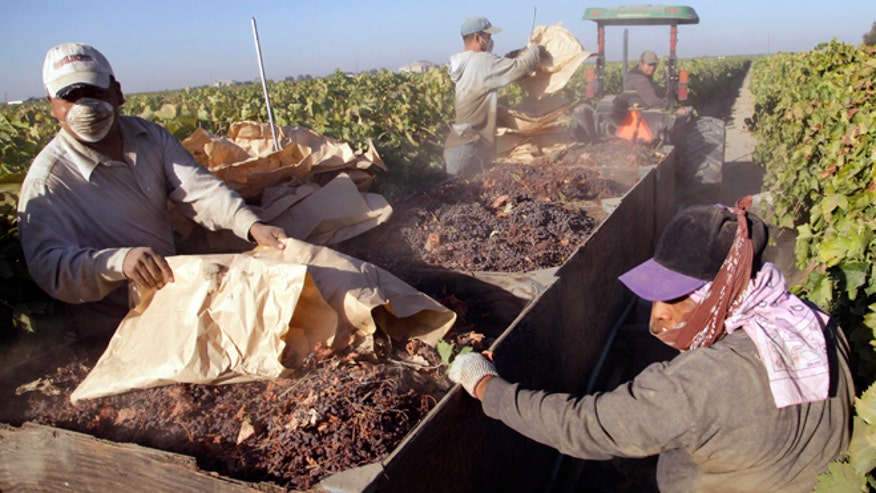
Sept. 24, 2013: In this file photo taken near Fresno, Calif., farmworkers pick paper trays of dried raisins off the ground and heap them onto a trailer in the final step of raisin harvest. Thousands of farmworkers in California, the nations leading grower of fruits, vegetables and nuts may soon be able to leave the uncertainty of their seasonal jobs for steady, year-around work building homes, cooking in restaurants and cleaning hotel rooms. (AP/File)
Farmers already scrambling to find workers in California — the nation's leading grower of fruits, vegetables and nuts — fear an even greater labor shortage under President Barack Obama's executive action to block some 5 million people from deportation.
Thousands of the state's farmworkers, who make up a significant portion of those who will benefit, may choose to leave the uncertainty of their seasonal jobs for steady, year-around work building homes, cooking in restaurants and cleaning hotel rooms.
"This action isn't going to bring new workers to agriculture," said Jason Resnick, vice president and general counsel of the powerful trade association Western Growers. "It's possible that because of this action, agriculture will lose workers without any mechanism to bring in new workers."
Although details of the president's immigration policy have yet to be worked out, Resnick said the agricultural workforce has been declining for a decade. Today, the association estimates there is a 15 to 20 percent shortage of farmworkers, which is driving the industry to call for substantial immigration reform from Congress, such as a sound guest worker program.
"Hopefully there will be the opportunity for comprehensive immigration reform," said Karen Ross, secretary of the California Department of Food and Agriculture. "That's the right thing to do for this country."
California's 330,000 farmworkers account for the largest share of the 2.1 million nationwide, according to the U.S. Bureau of Labor Statistics. Texas comes in a distant second with less than half of California's farmworkers.
Once Obama's executive action starts going into effect next year, it will protect the parents of legal U.S. residents from deportation and expand a 2012 program that shields from deportation people brought into the U.S. illegally as children.
Manuel Cunha, president of the Fresno-based Nisei Farmers League, estimates that 85 percent of California's agricultural workers are using false documents to obtain work.
Cunha, who has advised the Obama administration on immigration policy, figures that 50,000 of the state's farmworkers who may benefit from the president's executive action could leave the fields and packing houses in California's $46.4 billion agricultural industry.
"How do I replace that?" he said. "I think we're going to have a problem."
Many farmworkers are paid above minimum wage, earning more hourly than they will in other industries, but he said that workers that leave will gain year-around jobs and regular paychecks, rather than seasonal employment.
While farmers may face a setback, Obama's order is good for workers, who support families and fear that any day they may be pulled over driving to work and deported, said Armando Elenes, national vice president of the United Farm Workers.
With proper documentation, workers will feel empowered and be more valuable, Elenes said. Confronted with abuse at work — such as being paid less than minimum wage or denied overtime — workers will be able to challenge their employer or leave, he said.
In addition, their newfound mobility will create competition for farmworkers and potentially increase wages, Elenes said, adding, "It's going to open up a whole new world for workers. A lot of times, if you're undocumented, you feel like you're stuck."
Ed Kissam, an immigration researcher at the immigrant advocacy group, WKF Giving Fund, said he doubts a significant number of farmworkers will leave the industry. Farmworkers often lack the language, education and technical skills to move up the employment ladder, he said. "Surely some will," Kissam said. "It's not going to be a mass exodus."
Edward Taylor, a researcher at the University of California, Davis, said a shortage of farmworkers could be exacerbated by a dwindling flow of workers from Mexico, the largest supplier of labor to the United States. Taylor said the lower birthrates, more industrial jobs and better schools in rural Mexico are cutting into the supply of farmworkers.
"U.S. and Mexican farmers have to compete for that diminishing supply of farm labor," he said. "Once this change hits, there's no going back."
Central Valley farmer Harold McClarty of HMC Farms, who hires a thousand workers at harvest time, said there is no replacing the human hand for picking the 50 varieties of peaches he grows. His workers pick a single tree five or more times, making sure the fruit they take is ripe.
"We haven't found any machines that can do anything like that," he said. "You can't just pick the whole tree."

Monday, December 22, 2014

African Bushmeat Is Ebola's Back Door to America


African Bushmeat Is Ebola's Back Door to America


2014_08_15_Cover_600x800


While the focus remains on the passengers of trans-Atlantic flights, there is an additional risk—all but ignored by the popular press and public—lurking in the cargo hold below: bushmeat contaminated with the Ebola virus and smuggled into the U.S. in luggage.
08_22_Bushmeat_01 A bowl containing cooked monkey bushmeat makes its way to the local Nayabissam market on July 27, 2011 in Nayabissam, Cameroon.
That Special-Occasions Meat
Under U.S. Department of Agriculture rules, not a single African country is allowed to import any meat product, raw or processed. And for years now, U.S. health officials and legislators have been expressing concern over the steady flow of bushmeat illegally imported into the country. Internal documents show that from 2009 to 2013, the U.S. Customs and Border Protection agency confiscated over 69,000 different bushmeat items, with seizures ranging from dried bat to smoked monkey (see sidebar). And that’s likely a mere sliver compared with what actually gets into the U.S. At least one estimate puts the number at 15,000 pounds every month.
“Nobody knows” how much of the stuff gets into America, says Allard Blom of the World Wildlife Fund. “It’s anybody’s guess, really, because there’s very little control on the import of bushmeats. You’re looking here particularly at Fish and Wildlife Service [FWS], and they have very few agents that are working at these airports, and very few pieces of luggage are actually screened.”
Via email, an agency spokeswoman says, “It’s misleading to cite only Fish and Wildlife Service staffing levels.”


Three other agencies are responsible for enforcing import restrictions, according to the FWS: “Bushmeat as meat is also regulated on import by the Food and Drug Administration (from a human health perspective), Centers for Disease Control (from a human health and primate perspective) and USDA (from an agricultural perspective concerned with animal diseases).” Customs, which works under the Department of Homeland Security, is responsible for coordinating these four agencies. The inadequate enforcement could be a function of this diffusion of responsibility, or there might be “questions about what exactly is legal and what is not,” says Blom. In other words, customs agents may simply not recognize what they are looking at when encountering bushmeat.
“I’ve seen bushmeat being brought into the U.S. in basically big suitcases of smoked meat or coolers brought on planes,” says Blom.
Back in the Bronx, Appiah confirms that plenty of the stuff gets past the gatekeepers. “Immigration in America is trying to control it…but always they find a way of bringing [bushmeat] in here,” he told Newsweek in his thick accent, adding, “It’s all around.”
New York City, home to nearly 77,000 West Africans (most of them in the Bronx), is the epicenter of the bushmeat trade in the U.S. There are very few direct flights from West Africa to the U.S.; the majority of travelers first pass through Western Europe before connecting to New York. One recent study estimated that 273 tons of bushmeat is imported into Charles de Gaulle Airport on Air France carriers every year. From France, the imported goods often travel on to America.
Smuggling continues to grow because bushmeat is prized, and increasingly valuable. According to a 2002 congressional hearing, the total value of the bushmeat trade had “reached the staggering level of more than $50 million annually and potentially could grow to hundreds of millions of dollars in the next two decades.” Because of the illegal nature of the bushmeat trade, precise data are not available. However, as the number of African-born immigrants in the U.S. has grown in the past decade, it’s likely that the trade has increased.
Bushmeat is also associated with magical and medicinal properties—in 1999, two researchers in Nigeria examined the stalls of dozens of traders in traditional medicine ingredients and found 45 different animals for sale (living or dead), including primates, bats, great cats (lions and leopards) and the aforementioned cane rat. In some parts of Western Africa, large quantities of bushmeat must be served to the participants at circumcision ceremonies.

08_22_Bushmeat_02


Bushmeat is, for many West Africans, a cultural touchstone. Liberian expat Edward Lama Wonkeryor, a professor of African American Studies at Temple University, told The New York Times that back in the 1970s his mother used to sneak cuts of smoked monkey, bush hog or lion into his suitcase before he returned to the U.S. after a visit home. He would save them for special events, like weddings and christenings.
Health workers carry the body of a man suspected of dying from the Ebola virus, in the capital city of Monrovia, Liberia, on August 12, 2014.
That Most Dangerous Meat
Though researchers cannot identify with absolute certainty the cause of the current Ebola outbreak, they do know the strain of virus, while being similar to the Zaire strain, is indigenous to Guinea, suggesting bushmeat was the source.
Fruit bats are believed to be the “natural reservoir” of Ebola (meaning the virus can live in the bats for years without harming them), and scientists presume the virus makes its way into primates and other animals when they eat fruits half-eaten by and contaminated with the saliva of these bats. From those infected animals, the virus jumps to humans. 
“Just under 50 percent of Ebola outbreaks have been due to known handling of primate, great ape carcasses,” says Michael Jarvis, a virology and immunology expert at Britain’s Plymouth University.  
The most likely scenario for the jump is when an infected animal is being butchered and blood seeps into a cut on the hunter’s (or butcher’s) hand. “But we don’t know precisely,” says Dr. George Amato, director of the Sackler Institute for Comparative Genomics at the American Museum of Natural History. Amato adds that it’s also very possible that eating infected, improperly prepared meat could spread Ebola.
Fruit bats and primates are two common forms of bushmeat consumed every day by people in Africa, and by those Africans living in the U.S. who have managed to find an illegal supplier.

In a 2012 study, researchers working with government officials at John F. Kennedy Airport in the borough of Queens, New York (and some smaller airports) tested confiscated bushmeat, including baboon, chimpanzee, mangabey, guenon, green monkey and cane rat. They found that the meat does not arrive alone; it carries with it many unseen microorganisms.
Smoked bushmeat may appear safe, but the flesh inside is still juicy—filled with blood, fresh tissue and more: Simian foamy virus and herpes viruses showed up in the samples of the confiscated meats. The researchers didn’t find Ebola, but they tested only a few samples.
Cooking meat thoroughly will generally kill all pathogens, including viruses and bacteria, but most of the bushmeat arriving in the U.S. has been just barely processed in order to keep it from rotting while being transported. “If you wanted to safely transport meat and not worry about pathogens, you wouldn’t smoke it,” says Amato. “It’s not a very efficient way of killing microorganisms.”
In addition, bushmeat may serve as a potential route for other diseases, “especially some of the livestock diseases, [like] hoof-and-mouth and African swine fever. Those can survive a very long time in a piece of meat,” says Bill Karesh, one of the authors of the 2012 study and a public health policy expert at EcoHealth Alliance. These and other pathogens could present dangers equally—or more—frightening than an Ebola outbreak.
Bushmeat
Viral Chatter Goes Viral
In a 2007 report, the World Health Organization warned that infectious diseases are now emerging at a rapid and previously unseen rate. New viruses and bacteria keep appearing, while familiar pathogens, previously thought to have been suppressed, reemerge. These old viruses and bacteria either change genetically, re-combine with other pathogens or adapt in a way that fools our immune systems, becoming newly empowered to ruin our bodies. Such was the case with the swine and bird flu outbreaks of the past decade.
Nearly 75 percent of these emerging infectious diseases come from animal species, and of those, the majority were in the wild. Better prediction and prevention of these emerging diseases requires closer monitoring of individuals who have a lot of contact with bushmeat to look for what Dr. Amesh Adalja, of the University of Pittsburgh Medical Center’s Center for Health Security, calls viral chatter.
Viral chatter, he explains, occurs when viruses jump from wild animals into people. Though it may feel as if viruses attack humans en masse in one big offensive, what’s really happening is a series of ongoing, tentative incursions. During these incursions, the viruses can mutate, becoming more easily transmitted, more deadly or both. Not every new virus we see in humans will cause sickness or symptoms, but by monitoring viral chatter, we could potentially uncover trends that might help prevent the spread of future viruses that do cause sickness, or worse.
If scientists had been monitoring viral chatter in the past, one tragic public health story may have developed quite differently. Human immunodeficiency virus (HIV) almost certainly was transferred from bushmeat. “We have an awful lot of evidence [that] this virus moved from chimpanzees to people,” says Amato. “The most likely way that move happened was because people ate chimpanzees.”
08_22_Bushmeat_04
A bushmeat seller holds a monkey at the bushmeat market of Yopougon in Abidjan, Ivory Coast, May 12, 2006.


 Epidemiologists believe that HIV is a descendent of simian immunodeficiency virus (SIV), which is found in primates like the sooty mangabey, which is indigenous—and hunted—in Western Africa. The virus likely began to infect humans first as SIV, then slowly gained the mutations that led, ultimately, to the shift to HIV.
“If people were monitoring these bushmeat hunters in Cameroon in the early 1900s, you might have seen SIV jumping into them before it became HIV,” Adalja says.
Such global viral forecasting is even more important today. With people traveling far and wide—and bushmeat reaching certain regions of the globe for the first time—more opportunities exist for the spread of viral diseases. “The perfect example is China, where they’re harvesting lots of wildlife of all kinds, they’re storing it all on top of each other in warehouses and markets,” says Amato. “You’re sort of creating this very strange evolutionary environment where pathogens and other microorganisms that never would come into contact with each other are coming into contact with each other.”
These environments can encourage what’s called horizontal gene transfer, where genes from one virus move into another virus when they are infecting the same organism. In the most frightening type of horizontal gene transfer, a robust but harmless virus could transfer its genetic propensity for resilience to a deadly but fragile virus, creating some new supervirus that might lead to a SARS-like epidemic. It’s no coincidence that the 2002-2003 SARS outbreak was born in the live animal markets of southern China; the virus originated in bats, where it would have stayed permanently, except for the fact that in the markets infected bats were kept in cages near civets (a small cat-like mammal). Humans didn’t eat the bats, but they did eat the civets. And at some point the disease moved from bat to civet to human, acquiring mutations along the way that enabled it to infect over 8,000 people in 37 different countries.
Cutting the Roots
Last month, when news of the Ebola outbreak began to pick up steam, Appiah returned to his native Ghana to gather up his three children (including Princess, who was with him when we spoke) who were still living there and then hurried back to the Bronx.
“I just brought all my kids here…because it’s dangerous,” he tells Newsweek. “You can’t put trust in West African government to combat diseases.” Although no cases of Ebola have been confirmed in Ghana, Appiah isn’t taking any chances, with Liberia (which has 166 confirmed cases as of this writing) and Guinea (369) just a few hundred miles away.
Meanwhile, demand for bushmeat in Appiah’s neighborhood has “drastically dropped,” he says because of the growing fears surrounding the Ebola outbreak. “Now when you go to the African market and you ask, they don’t have it,” he says. He recently decided to cut out his favorite ethnic dish from his diet.
In the Bronx and other parts of the city with large enclaves of West African immigrants, Newsweek could not find bushmeat for sale. Targeting small merchants, however, will not stem the illegal bushmeat trade or the potential spread of diseases like Ebola. Instead, the commercial trade in Africa must be curbed, which will require greater action and cooperation from African governments and increased international efforts—a daunting task, considering how popular bushmeat is on the continent.
Appiah tells Newsweek that when he was last in Ghana, he tried to warn people of the dangers of bushmeat. But he found that the locals, even when they understood the grave risk, ignored his advice.
“They don’t have an alternative,” he says. “They have to eat.”


Sunday, December 21, 2014

Federal Hackers Bug CBS Reporter's Computer; NC Conservative Blogger Suspects Same Intrusions.

FEDERAL HACKING OF CONSERVATIVE NEWS IS A FACT

Verne Strickland: Wilmington NC Dec. 21, 2014
This story is personal to me because I know that the posts on my conservative Christian blog are altered -- text and photos -- censored (cut short) and removed from availability on the net. I hasten to say that, while an allegation is made by national CBS reporter Sharyl Attkisson, my own posts are not as broadly circulated, although they do reach a wide and loyal audience. Still, I am vexed at the abuse of my rights, and being singled out for this treatment. I will not go quietly. 


CBS News:
"Sharyl Attkisson has just published a book, Stonewalled, detailing her difficulties covering the Obama White House when she was at CBS. The network confirmed in 2013 that her computer had been bugged. At the time, she was covering both the Benghazi and Fast and Furious scandals. 

 CBS said at the time:
"A cyber security firm hired by CBS News has determined through forensic analysis that Sharyl Attkisson’s computer was accessed by an unauthorized, external, unknown party on multiple occasions late in 2012.
" …an intruder had executed commands that appeared to involve search and exfiltration of data.
"This party also used sophisticated methods to remove all possible indications of unauthorized activity, and alter system times to cause further confusion.
"Attkisson suspects her computer was hacked by a government agency. She says:
"(The hacking was done by) a sophisticated entity that used commercial, nonattributable spyware that’s proprietary to a government agency: either the CIA, FBI, the Defense Intelligence Agency or the National Security Agency."
Ex-CBS Reporter Attkisson: ‘Government-Related Entity’ Bugged Computer, Planted Secret Docs

Former CBS reporter Sharyl Attkisson alleges that a “government-related entity” hacked into her computer, monitoring her activity and planting classified government documents deep in her operating system in what she fears was a plan to lay the groundwork for future charges against her or her sources.
In February 2012, just a few months after her first story on the Department of Justice’s “Fast and Furious” scandal, Attkisson received what she describes as an ”otherwise innocuous email.” In the New York Post’s preview of her new book, Stonewalled, the ex-reporter explains how that e-mail allowed a “government-related entity” to track her every keystroke and access her e-mails and private passwords.
Attkisson discovered the breach through a source “connected to government three-letter agencies.” That source found something even more sinister hidden deep inside her computer’s operating system — confidential government documents that she fears were placed there to give the government a case against her or sources that could have “leaked” the documents.
“This is outrageous,” Attkisson quotes her source as saying. “Worse than anything Nixon ever did. I wouldn’t have believed something like this could happen in the United States of America.”
The source explained that the hacking was undoubtedly accomplished by “a sophisticated entity that used commercial, nonattributable spyware that’s proprietary to a government agency: either the CIA, FBI, the Defense Intelligence Agency or the National Security Agency.”