Wednesday, October 17, 2012

CNN's Crowley first plays umpire, then joins Team Obama


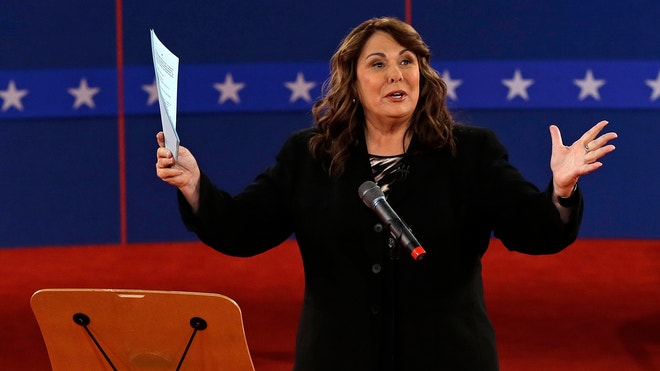
  • CandyCrowley.JPG
    Oct. 16, 2012: Moderator Candy Crowley talks to the
     audience before the second presidential debate at
     Hofstra University. (AP)
In the baseball playoffs, the tie goes to the runner. In debates, ties are decided by the moderator and that’s what happened during the Tuesday night presidential debate at Hofstra University in New York. CNN’s Candy Crowley made her presence felt as a moderator in a major way on two points, but none larger than the issue of Libya.

The terrorist attack that killed Ambassador Chris Stevens and four others in Benghazi has become a sore point for Obama, but Crowley made sure she called Romney out before Obama could tag him.

When Romney said Obama had not called the attack an act of terror for 14 days, Crowley interrupted and said: “It -- it -- it -- he did in fact, sir. So let me -- let me call it an act of terror.”

Naturally, Obama asked her to restate her point and she did. “Can you say that a little louder, Candy?” asked the president. “He -- he did call it an act of terror. It did as well take -- it did as well take two weeks or so for the whole idea there being a riot out there about this tape to come out. You are correct about that,” she continued.
Conservatives were outraged, arguing that Crowley’s interruption spoiled a key Romney point. They weren’t the only ones. Even Politico’s Mike Allen called the Crowley point “arguable” and pointed to the transcript of Obama’s statement saying it “generally” referred to “acts of terror.” CNN’s John King called the Obama statement a “generic” comment about terror, not specifically calling the Libya attack a terrorist act.

Afterward, CNN’s post-debate analysis team focused heavily on that point and Crowley herself admitted Romney had been right “in the main.” She said Romney “picked the wrong way to go about talking about it.” She also emphasized that each point she made also generated applause from one half of the audience, then the other.

But Crowley also admitted she took her cue to intervene from Obama. She said Libya was where Romney “tripped himself up.” But she clearly helped. After Romney made his point she cut in. “The president kept looking at me, going you … and I thought, well, I did know that, I said, he, you, he did, call it an act of terror.” She then chastised Romney because “he picked that one wrong fact.”

The Daily Caller’s Matt Lewis was understated, saying simply: “Candy Crowley seemed to side with Obama.” But The Washington Post blamed Romney’s reaction on conservative media.

 “Romney came off as being shellshocked by the mere suggestion” that he was wrong, wrote Erik Wemple. He continued his attack blaming the right. “Romney revealed that perhaps he’d spent some time inside a coverage bubble on the Benghazi story. In the words of one onlooker, he “[c]onfused conservative spin for the truth.”

However, the actual presidential transcript makes it clear that Obama was doing his best to include the word “terror” without actually saying the incident was a terror attack. After mentioning 9/11, Iraq and Afghanistan, the president said: “No acts of terror will ever shake the resolve of this great nation, alter that character or eclipse the light of the values that we stand for.” Then he moved on to the Libya attack.

That one moment defined the debate. Crowley, who had come under criticism from both sides prior to the debate, also cut off Romney when he was making a point about the president’s "Fast and Furious" gun scandal. And, as in the other two debates, the moderators let the Democratic candidate dominate the clock. This time, according to CNN’s own tally, Obama won 44 minutes and 4 seconds to a mere 40 minutes and 50 seconds for Romney.

Dan Gainor is the Boone Pickens Fellow and the Media Research Center’s Vice President for Business and Culture. He writes frequently about media for Fox News Opinion. He can also be contacted on Facebook and Twitter as dangainor.

Tuesday, October 16, 2012

Crowley's false fact check saves President, derails debate.

Verne Strickland Blogmaster / October 16, 2012

16 Oct 2012, 7:49 PM PDT
 

We're done with the second presidential debate, but it was apparent 45 minutes in that between the questions Crowley chose and her handling of who was allowed to speak and when, that this debate was a total and complete set up to rehabilitate Barack Obama. 

If these are truly undecided voters, they're apparently undecided between Obama and Green Party. Moreover, as I write this, Obama's already enjoyed four more minutes of speaking time than Romney. In a ninety-minute debate, that's a big deal.

The lowest and most dishonest part Crowley's disgraceful "moderation" was when she actually jumped into the debate to take Obama's side when the issue of Benghazi came up. To cover for his and his administration lying for almost two weeks about the attack coming as the result of a spontaneous protest over a YouTube video, Obama attempted to use as cover, he claimed he had called the attack a "terrorist attack" on that very first day during his Rose Garden statement.
Romney correctly disputed that.
Crowley, quite incorrectly, took Obama's side and the crowd exploded.
Here's what Obama said that day:
No acts of terror will ever shake the resolve of this great nation, alter that character or eclipse the light of the values that we stand for.
Context matters and the context here is that Obama connected this "act of terror" to … a mob action over a YouTube video -- not a deliberate terrorist attack. Obama was using the term generically and it would be almost two weeks before he used it again.
Let's not forget that Susan Rice said declaratively on the five Sunday shows four days later that it was NOT an act of terror.
And during those two weeks the Obama administration lied like a rug. For Crowley to step in and attempt to correct Romney on a statement that is at best arguable, was completely out of line. The debate over this debate has only begun.

 Follow John Nolte on Twitter @NolteNC 

ON BREITBART TV

Crowley Erroneously Sides With Obama Over Libya Terror Dispute
  •  

GOP-leaning group plans new $11 million ad blitz -- NC included.

americancrossroads.jpg 


BETH FOUHY
Associated Press / Oct. 16, 2012

NEW YORK (AP) -- A Republican-leaning independent group supporting GOP presidential nominee Mitt Romney is set to launch a major new television advertising blitz targeting women.

American Crossroads plans to run the ad in eight battleground states. The spot features a woman watching one of President Barack Obama's campaign commercials and asking about the jobs he has promised and wondering what the federal spending he has pushed for has produced.

She says, quote, "My family can't afford another four years like this."

American Crossroads was co-founded by Karl Rove, the longtime political counselor to former President George W. Bush. The group plans to spend $11.1 million to air the ad on national and local cable stations and in swing states Colorado, Florida, Iowa, Nevada, New Hampshire, North Carolina, Ohio and Virginia.

http://www.wwaytv3.com/2012/10/16/gop-leaning-group-plans-new-11-million-ad-blitz#.UH1yp2ez4eq


Monday, October 15, 2012

White House prepares retaliation for Ambassador's death.

Verne Strickland / October 16, 2012


Monday, 15 Oct 2012 02:04 PM

The White House has put special operations strike forces on standby and moved drones into the skies above Africa, ready to strike militant targets from Libya to Mali — if investigators can find the al-Qaida-linked group responsible for the death of the U.S. ambassador and three other Americans in Libya.

But officials say the administration, with weeks until the presidential election, is weighing whether the short-term payoff of exacting retribution on al-Qaida is worth the risk that such strikes could elevate the group's profile in the region, alienate governments the U.S. needs to fight it in the future and do little to slow the growing terror threat in North Africa.

Urgent Poll: Romney or Obama to Handle Foreign Crisis? Vote Here!

Details on the administration's position and on its search for a possible target were provided by three current and one former administration official, as well as an analyst who was approached by the White House for help. All four spoke on condition of anonymity because they were not authorized to discuss the high-level debates publicly.

The dilemma shows the tension of the White House's need to demonstrate it is responding forcefully to al-Qaida, balanced against its long-term plans to develop relationships and trust with local governments and build a permanent U.S. counterterrorist network in the region.

Vice President Joe Biden pledged in his debate last week with Republican vice presidential nominee Paul Ryan to find those responsible for the Sept. 11 attack on the U.S. Consulate in Benghazi that killed Ambassador Chris Stevens and three others.

"We will find and bring to justice the men who did this," Biden said in response to a question about whether intelligence failures led to lax security around Stevens and the consulate. Referring back to the raid that killed Osama bin Laden last year, Biden said American counterterror policy should be, "if you do harm to America, we will track you to the gates of hell if need be."

The White House declined to comment on the debate over how best to respond to the Benghazi attack.

The attack has become an issue in the U.S. election season, with Republicans accusing the Obama administration of being slow to label the assault an act of terrorism early on, and slow to strike back at those responsible.

Urgent Poll: Romney or Obama to Handle Foreign Crisis? Vote Here!

"They are aiming for a small pop, a flash in the pan, so as to be able to say, 'Hey, we're doing something about it,'" said retired Air Force Lt. Col. Rudy Attalah, the former Africa counterterrorism director for the Department of Defense under President George W. Bush.

Attalah noted that in 1998, after the embassy bombing in Nairobi, the Clinton administration fired cruise missiles to take out a pharmaceutical factory in Sudan that may have been producing chemical weapons for al-Qaida.

"It was a way to say, 'Look, we did something,'" he said.

A Washington-based analyst with extensive experience in Africa said that administration officials have approached him asking for help in connecting the dots to Mali, whose northern half fell to al-Qaida-linked rebels this spring. They wanted to know if he could suggest potential targets, which he says he was not able to do.

"The civilian side is looking into doing something, and is running into a lot of pushback from the military side," the analyst said. "The resistance that is coming from the military side is because the military has both worked in the region and trained in the region. So they are more realistic."
 .
"If America hits us, I promise you that we will multiply the Sept. 11 attack by 10," said Oumar Ould Hamaha, a spokesman for the Islamists in northern Mali, while denying that his group or al-Qaida fighters based in Mali played a role in the Benghazi attack.

Finding the militants who overwhelmed a small security force at the consulate isn't going to be easy. The key suspects are members of the Libyan militia group Ansar al-Shariah. The group has denied responsibility, but eyewitnesses saw Ansar fighters at the consulate, and U.S. intelligence intercepted phone calls after the attack from Ansar fighters to leaders of al-Qaida in the Islamic Maghreb, or AQIM, bragging about it. The affiliate's leaders are known to be mostly in northern Mali, where they have seized a territory as large as Texas following a coup in the country's capital.

Urgent Poll: Romney or Obama to Handle Foreign Crisis? Vote Here!

But U.S. investigators have only loosely linked "one or two names" to the attack, and they lack proof that it was planned ahead of time, or that the local fighters had any help from the larger al-Qaida affiliate, officials say.

If that proof is found, the White House must decide whether to ask Libyan security forces to arrest the suspects with an eye to extraditing them to the U.S. for trial, or to simply target the suspects with U.S. covert action.

U.S. officials say covert action is more likely. The FBI couldn't gain access to the consulate until weeks after the attack, so it is unlikely it will be able to build a strong criminal case. The U.S. is also leery of trusting the arrest and questioning of the suspects to the fledgling Libyan security forces and legal system still building after the overthrow of Moammar Gadhafi in 2011.

The burden of proof for U.S. covert action is far lower, but action by the CIA or special operations forces still requires a body of evidence that shows the suspect either took part in the violence or presents a "continuing and persistent, imminent threat" to U.S. targets, current and former officials said.

"If the people who were targeted were themselves directly complicit in this attack or directly affiliated with a group strongly implicated in the attack, then you can make an argument of imminence of threat," said Robert Grenier, former director of the CIA's Counterterrorism Center.
But if the U.S. acts alone to target them in Africa, " it raises all kinds of sovereignty issues ... and makes people very uncomfortable," said Grenier, who has criticized the CIA's heavy use of drones in Pakistan without that government's support.

Even a strike that happens with permission could prove problematic, especially in Libya or Mali where al-Qaida supporters are currently based. Both countries have fragile, interim governments that could lose popular support if they are seen allowing the U.S. unfettered access to hunt al-Qaida.

The Libyan government is so wary of the U.S. investigation expanding into unilateral action that it refused requests to arm the drones now being flown over Libya. Libyan officials have complained publicly that they were unaware of how large the U.S. intelligence presence was in Benghazi until a couple of dozen U.S. officials showed up at the airport after the attack, waiting to be evacuated — roughly twice the number of U.S. staff the Libyans thought were there. A number of those waiting to be evacuated worked for U.S. intelligence, according to two American officials.

In Mali, U.S. officials have urged the government to allow special operations trainers to return, to work with Mali's forces to push al-Qaida out of that country's northern area. AQIM is among the groups that filled the power vacuum after a coup by rebellious Malian forces in March. U.S. special operations forces trainers left Mali just days after the coup. While such trainers have not been invited to return, the U.S. has expanded its intelligence effort on Mali, focusing satellite and spy flights over the contested northern region to track and map the militant groups vying for control of the territory, officials say.

In northern Mali, residents in the three largest cities say they hear the sound of airplanes overhead but can't spot them. That's standard for drones, which are often invisible to the naked eye, flying several thousand feet above ground.

Urgent Poll: Romney or Obama to Handle Foreign Crisis? Vote Here!

Residents say the plane sounds have increased sharply in recent weeks, following both the attack in Benghazi and the growing calls for a military intervention in Mali. Chabane Arby, a 23-year-old student from Timbuktu, said the planes make a growling sound overhead. "When they hear them, the Islamists come out and start shooting into the sky," he said.

Aboubacrine Aidarra, another resident of Timbuktu, said the planes circle overhead both day and night. "I have a friend who said he recently saw six at one time, circling overhead . . . They are planes that fly at high altitudes. But they make a big sound. "

Israeli flags now illegal in 'Dearbornistan'? The hell you say!


Verne Strickland / October 15, 2012


October 15, 2012 By

First, Christians were banned in Dearbornistan. Now, it’s Jews who are illegal. Why not just declare the
place an outpost of Saudi Arabia and be done with the whole business.
“On 9-14-2012, Dearborn Fordson High School principal called the police on me for driving with 2 Israeli flags on my truck.
When the students began their assault he rolled down his window asking them to stop. After they pulled him over the police used the rolled down window as a pretext to accuse him of instigating the altercation.  While being questioned by the police in front of the high school the reader received death threats. The police denied hearing them though the individuals involved were only a few feet away.
“The Dearborn police were one car behind me when this student threw a bottle on my windshield. The police did not stop the student, but instead stopped me for 30 minutes asking me why I would display Israeli flags on my truck.”
This is how hellholes like Malmo get started. When the law becomes a tool for enforcing Muslim prejudices, then equal rights go out the window and police lecture anyone attacked by Muslims on what they did to provoke the attack.

But it’s not just Dearborn. The consensus of our governing elites is that making a movie mocking Mohammed is a crime that deserves to be punished. So why not driving with an Israeli flag as well? Where do we draw the line? Anywhere Muslim violence tells us to.

Tim D'Annunzio challenges incumbent David Price in NC/4

Verne Strickland Blogmaster / October 15, 2012
Longtime Democratic Congressman David Price will face off against Raeford businessman Tim D'Annunzio in the recently remapped District 4 congressional race in November.
The district, which was redrawn by the Republican-controlled state legislature, spans from Alamance County through Chapel Hill, Raleigh and parts of Chatham, Lee and Harnett counties to northern Cumberland County.

Price, a former Duke political science professor, has served 12 terms since 1987. He believes a strong infrastructure includes the re-hiring of teachers, police and firefighters who were laid off during budget cuts.
Price said he also favors a plan that, along with spending cuts, includes taxing the wealthiest Americans.

D'Annunzio, a Republican from Raeford, founded Paraclete Armor and Equipment Inc., which he sold. He owns Paraclete XP SkyVenture and XPX Armor & Equipment.

D'Annunzio's radio ads have accused the presidential administration of socialist practices, and he advocates for a limited government and deregulation of industry.

He also believes in eliminating many federal departments and agencies, including the U.S. Department of Education, the Department of Housing and Urban Development, the Department of Health & Human Services, the Department of Energy and the Environmental Protection Agency.

D'Annunzio, who has been known for his machine gun social fundraisers, made an unsuccessful run in the Republican primary for the 8th Congressional District in 2010, before redistricting. The nomination went to Tim Johnson, who lost to Democratic Rep. Larry Kissell in the general election.

The district lines have changed, but the issues have stayed the same, the candidates say. Jobs and the economy take top billing, just as they will in most elections across the country, Price and D'Annunzio said.

"Of course it's jobs," said D'Annunzio, who was backed in the primary by We the People of the Sandhills, a Fayetteville-based tea party chapter. "The state has one of the highest unemployment rates in this country."
North Carolina's unemployment rate stood at 9.7 percent in August, when the latest numbers were released by the state's Employment Security Commission.

Cumberland County's rose to 11.4 percent, but other counties in District 4 performed relatively well. Wake County's unemployment rate was at 7.6 percent, Durham County's was at 8 percent and Orange County's was at 11.4 percent.

Despite their differences, both candidates agreed the 4th District was one of the more resilient and economically diverse in the state. The district's territory in Orange, Durham and Wake counties is home to technology companies, while Cumberland County has defense industries.

Because of the relatively sturdy economy in the district, Price said, the region is an example of how government can help strengthen education, help develop high-tech firms and nurture start-ups and innovative ideas.

"It's a proven formula," Price said. "What's alarming is the arrival (of politicians) in Washington and Raleigh who don't seem to understand that. They have failed to learn that basic lesson in history."
D'Annunzio said Congress will be required to vote on legislation that will affect the entire country, which has suffered in the economic downturn.

"One of the problems we have is ever-increasing debt that's draining off capital and resources from private companies," he said.

D'Annunzio said the country operates on a type of budgeting system that involves increases already programmed into the system.

"What we need to do is get rid of base-line budgeting," he said.
D'Annunzio also said he believes in "orderly downsizing."

Price, who serves on the House Appropriations Committee and is the ranking Democrat on the Homeland Security Appropriations Subcommittee, has supported bills for affordable housing and to allow families to deduct interest on student loans and make penalty-free IRA withdrawals for education.

"It's important for our country to invest in its people," Price said. "I also happen to believe that expanding the economy is the best solution to the deficit. You can't cut your way to prosperity."

U.S. House District 4
DAVID E. PRICE (I)
Party: Democrat
Home: Chapel Hill
Age: 72
Occupation: Educator and U.S. representative
Elected offices: U.S. House, 12 terms (1987-1995, 1997-present)
Family: Wife, Lisa; two children
Contacts: 919-854-4155, david@pricecampaign.com, priceforcongress.com, facebook.com/david-price, Twitter: DPrice4Congress

TIM D'ANNUNZIO
Party: Republican
Home: Raeford
Age: 54
Occupation: Owner, XPX Armor & Equipment/Paraclete XP
Elected offices: None
Family: Wife, Colleen; six children
Contacts: 910-222-4461, info@timvote.com, facebook.com/tim.dannunzio

Staff writer Jennifer Calhoun can be reached at 486-3595.

Sunday, October 14, 2012

School choice criticism wilts under close review

Posted on October 10, 2012 by Bob Luebke in Education

A recent poll of North Carolinians by the Civitas Institute and the Friedman Foundation reported that if given a choice of where to educate their child, only 34 percent of respondents said they would choose a traditional public school. Almost two-thirds of respondents (65 percent) said they would enroll their child in other educational options such as charter schools (15 percent), private schools (39 percent) or home schools (11 percent).
Yet approximately 87 percent of all K-12 students are enrolled in public schools.
These poll findings illustrate a major disconnect between what school choices parents would like to have, compared to the choices that are realistically available.
Moreover, these findings demonstrate the popularity of school choice among the general public. School choice options are likely to receive serious consideration when the North Carolina General Assembly convenes next year. Not surprisingly, these developments have raised the noise volume of complaints by school choice critics.
Two of the most common criticisms of school choice revolve around a couple of assertions: (1) School choice is costly and takes money from the public schools; and (2) school choice allows private schools to “cherry pick” students and leads to segregated schools. Are these claims true?
No! Let’s look at them more closely.
The claim that school choice siphons money from the public schools is based on the simplistic view that if funding is driven by the number of students enrolled and the number of students declines; funding would also decline. Such thinking is flawed, however.
It is true that a loss in students would result in a decline in total revenue. But what is often forgotten is that such changes are offset by cost reductions resulting from the smaller student population. Fewer teachers, instructional support personnel, books, etc. would be required. It is also true that when schools experience enrollment declines, funding declines at a slower rate so as to ease the effect of the loss of student revenue.[1]  The effect is to essentially provide additional money to compensate for absent students.
Additionally, rarely if ever do school choice vouchers provide 100 percent of state education costs to voucher recipients. Thus, taxpayers save money because the voucherized student costs less than if she stayed in a traditional public school.
School choice critics also assert that fewer students will result in fewer taxpayer dollars to educate all students and to cover schools’ fixed costs. Not so, says one school finance expert. In The Fiscal Effects of Public School Choice Programs on Public School Districts, Benjamin Scafidi asks: If a significant number of students left a public school district for any reason from one year to the next, then is it feasible for the district to reduce some of its expenditures commensurate with the decrease in the student population? After analyzing the finances of districts that lost students, Scafidi found that both large and small districts were able to reduce expenses at a rate higher than what is needed to make up for the losses in students. Thus, school districts were more than able to treat certain costs as variable in the short run, and therefore adjust for the changes. Scafidi goes even further and says that such losses in enrollment due to available school choice options can actually help to improve academic performance by forcing some schools to get rid of ineffective teachers and providing more incentives to improve the public schools.[2]
A second common criticism of school choice programs is that they cherry-pick students and lead to increased segregation. Let’s address the first charge. Do parental choice policies like charter schools or tuition tax credits result in private schools “skimming off” the best students and leaving behind poorer, less able students?
Such a claim ignores the reality that, unlike public schools, private schools derive a high percentage of their revenue from tuition. By definition private schools are seeking to maximize enrollment. It defies logic that they would readily turn away students. Of course some private schools do turn away students. For instance, some private schools are not equipped to offer the same level of services for special-needs students. On the whole, however, private schools have strong incentives to accept students.
Moreover, the North Carolina statutes prohibit a charter school from discriminating against any student on the basis of ethnicity, national origin, gender, or disability (115C-238.29F(g)(5).
Critics also claim that school choice leads to more-segregated schools. The fact is, our nation’s public schools and districts are already heavily segregated. They are segregated primarily because of residential segregation and because public school attendance patterns are largely determined by where people live. The research backs up such claims. Studies in Cleveland[3], Milwaukee[4] and Washington, DC[5] all found that students in school choice programs attend more-highly integrated schools than their public school counterparts.
Desegregation efforts have largely failed because they are geographically limited. White families who move to the suburbs cannot legally be forced to bus their children across municipal lines. Private schools, by contrast, can draw students with no limitation to geography. In fact, private schools typically draw from a much larger geographic area than public schools. That means private schools can mitigate the effects of residential segregation in a way public schools cannot match.
Yes, public schools as a whole have more minority representation than private schools. However the distribution of minorities within the public and private-school sectors show that by detaching school assignments from residence, individual private schools are likely to be more integrated schools.
Recent polls indicate North Carolinians want school choice. The growing popularity of school choice has increased the noise volume of its critics. That however should not distract us from the facts. The beneficial fiscal impacts of school choice and the way school choice offers a better opportunity to integrate schools offer powerful reasons why it is a good option for students, parents and taxpayers and why North Carolina should move forward with expanding school choice for everyone.