Well, whoop de doo . . . I'm part of the world's aging population, and I'm not ready either! So what do I do? No, no THAT, you ugly person. If you don't mind, I'll just wait around until God calls me. Until then, you'll just have to put up with me.
Verne Strickland Age 76 October 1, 2013

KRISTEN GELINEAU
September 30, 2013 11:07 PM
The world is aging so fast that most countries are not
prepared to support their swelling numbers of elderly people, according
to a global study being issued Tuesday by the United Nations and an
elder rights group.
The report ranks the social and economic
well-being of elders in 91 countries, with Sweden coming out on top and
Afghanistan at the bottom. It reflects what advocates for the old have
been warning, with increasing urgency, for years: Nations are simply not
working quickly enough to cope with a population graying faster than
ever before. By the year 2050, for the first time in history, seniors
older than 60 will outnumber children younger than 15.
Truong Tien
Thao, who runs a small tea shop on the sidewalk near his home in Hanoi,
Vietnam, is 65 and acutely aware that he, like millions of others, is
plunging into old age without a safety net. He wishes he could retire,
but he and his 61-year-old wife depend on the $50 a month they earn from
the shop. And so every day, Thao rises early to open the stall at 6
a.m. and works until 2 p.m., when his wife takes over until closing.
"People
at my age should have a rest, but I still have to work to make our ends
meet," he says, while waiting for customers at the shop, which sells
green tea, cigarettes and chewing gum. "My wife and I have no pension,
no health insurance. I'm scared of thinking of being sick — I don't know
how I can pay for the medical care."
Thao's story reflects a key
point in the report, which was released early to The Associated Press:
Aging is an issue across the world. Perhaps surprisingly, the report
shows that the fastest aging countries are developing ones, such as
Jordan, Laos, Mongolia, Nicaragua and Vietnam, where the number of older
people will more than triple by 2050. All ranked in the bottom half of
the index.
The
Global AgeWatch Index (www.globalagewatch.org) was created by elder
advocacy group HelpAge International and the U.N. Population Fund in
part to address a lack of international data on the extent and impact of
global aging. The index, released on the U.N.'s International Day of
Older Persons, compiles data from the U.N., World Health Organization,
World Bank and other global agencies, and analyzes income, health,
education, employment and age-friendly environment in each country.
The
index was welcomed by elder rights advocates, who have long complained
that a lack of data has thwarted their attempts to raise the issue on
government agendas.
"Unless you measure something, it doesn't
really exist in the minds of decision-makers," said John Beard, Director
of Ageing and Life Course for the World Health Organization. "One of
the challenges for population aging is that we don't even collect the
data, let alone start to analyze it. ... For example, we've been talking
about how people are living longer, but I can't tell you people are
living longer and sicker, or longer in good health."
The report
fits into an increasingly complex picture of aging and what it means to
the world. On the one hand, the fact that people are living longer is a
testament to advances in health care and nutrition, and advocates
emphasize that the elderly should be seen not as a burden but as a
resource. On the other, many countries still lack a basic social
protection floor that provides income, health care and housing for their
senior citizens.
Afghanistan, for example, offers no pension to
those not in the government. Life expectancy is 59 years for men and 61
for women, compared to a global average of 68 for men and 72 for women,
according to U.N. data.
That
leaves Abdul Wasay struggling to survive. At 75, the former cook and
blacksmith spends most of his day trying to sell toothbrushes and
toothpaste on a busy street corner in Kabul's main market. The job nets
him just $6 a day — barely enough to support his wife. He can only
afford to buy meat twice a month; the family relies mainly on potatoes
and curried vegetables.
"It's difficult because my knees are weak
and I can't really stand for a long time," he says. "But what can I do?
It's even harder in winter, but I can't afford treatment."
Although
government hospitals are free, Wasay complains that they provide little
treatment and hardly any medicine. He wants to stop working in three
years, but is not sure his children can support him. He says many older
people cannot find work because they are not strong enough to do day
labor, and some resort to begging.
"You have to keep working no matter how old you are — no one is rich enough to stop," he says. "Life is very difficult."
Many
governments have resisted tackling the issue partly because it is
viewed as hugely complicated, negative and costly — which is not
necessarily true, says Silvia Stefanoni, chief executive of HelpAge
International. Japan and Germany, she says, have among the highest
proportions of elders in the world, but also boast steady economies.
"There's no evidence that an aging population is a population that is economically damaged," she says.
Prosperity
in itself does not guarantee protection for the old. The world's rising
economic powers — the so-called BRICS nations of Brazil, Russia, India,
China and South Africa — rank lower in the index than some poorer
countries such as Uruguay and Panama.
However, the report found,
wealthy nations are in general better prepared for aging than poorer
ones. Sweden, where the pension system is now 100 years old, makes the
top of the list because of its social support, education and health
coverage, followed by Norway, Germany, the Netherlands and Canada. The
United States comes in eighth.
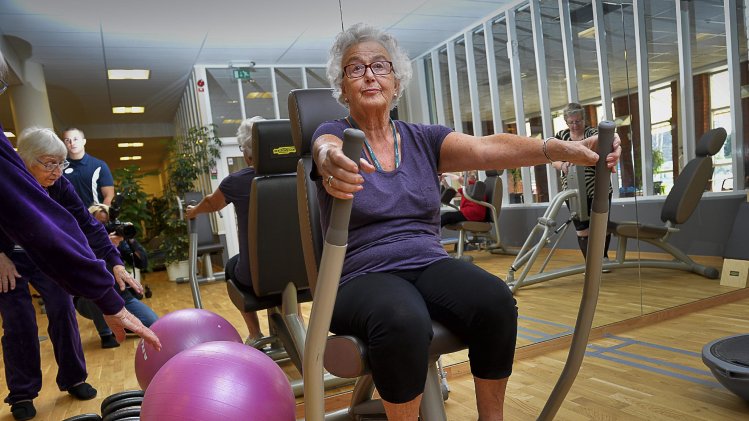
Sweden's health system earns praise from Marianne Blomberg, an 80-year-old Stockholm resident.
"The
health care system, for me, has worked extraordinarily well," she says.
"I suffer from atrial fibrillation and from the minute I call emergency
until I am discharged, it is absolutely amazing. I can't complain about
anything — even the food is good."
Still,
even in an elder-friendly country like Sweden, aging is not without its
challenges. The Swedish government has suggested people continue
working beyond 65, a prospect Blomberg cautiously welcomes but warns
should not be a requirement. Blomberg also criticized the nation's
finance minister, Anders Borg, for cutting taxes sharply for working
Swedes but only marginally for retirees.
"I go to lectures and
museums and the theater and those kinds of things, but I probably have
to stop that soon because it gets terribly expensive," she says. "If you
want to be active like me, it is hard. But to sit home and stare at the
walls doesn't cost anything."
___
Associated Press writers
Malin Rising in Stockholm, Tran Van Minh in Hanoi, Vietnam, and Amir
Shah in Kabul contributed to this report.


 Paul Hsieh